
A New Year's wish + invitation
Thank you for being a part of our Community Threads family! Having this space to share with you all and reading your emails about what you’ve gleaned from these newsletters have meant the world to me this past year.
So as we close the chapter on 2024 and enter 2025, I wanted to share with you a new year’s wish + invitation:
Thank you for being a part of our Community Threads family! Having this space to share with you all and reading your emails about what you’ve gleaned from these newsletters have meant the world to me this past year.
So as we close the chapter on 2024 and enter 2025, I wanted to share with you a new year’s wish + invitation:

We recognize 2025 is a new year with significant challenges - some old, some new. And we believe wholeheartedly that it is at the intersection of hope and action that we can work together to transform health in our communities.
In that spirit, here at PoP Health, we’ll be launching two new projects in 2025 - action planning workshops and technical assistance packages for community health coalitions + an initiative focused on putting political and economic power back in the hands of communities.
We’ll share with you along the way right here in our Community Threads newsletters. Please keep those replies coming - I love hearing from you!
In the meantime, as we find new ways to take action together, I remain ever grateful to you - thank you for reading.
Sign up to receive future newsletters directly in your inbox at www.pophealthllc.com!

Movements need weavers and warriors
What a week.
In the last issue of Community Threads, I spoke about how voting isn’t enough - that we need to organize movements. That remains true regardless of who wins an election or which political party is in power.
We need to come together - in a highly organized, long-term, consistent way - to make collective demands for concrete changes. We need movements.
And movements need both weavers and warriors.
What a week.
In the last issue of Community Threads, I spoke about how voting isn’t enough - that we need to organize movements. That remains true regardless of who wins an election or which political party is in power.
We need to come together - in a highly organized, long-term, consistent way - to make collective demands for concrete changes. We need movements.
And movements need both weavers and warriors.
Weavers that bring separate threads together to create a collective fabric - that bring organizations and individuals together for a common purpose, that build stronger connections, that persuade more people to join together, that reach across aisles, that take collective action.
Warriors that fight for the changes they want to see - that go up against power, that resist what they know is not right, that protest against injustice.

I’ve always considered myself a weaver - everything from the name of this newsletter (Community Threads) to PoP Health’s logo (which emphasizes interconnectedness) go back to the ideas of working together for collective impact. It’s why I love working with community coalitions and collaboratives.
And yet, I find myself venturing more into warrior territory these days. PoP Health has a new initiative coming down the pike (in Spring 2025) that’s focused on putting political and economic power back in the hands of communities, as opposed to corporate interests. And it has me fired up.
It makes me wonder if those of us who have both weavers and warriors in us - and those spaces where weavers and warriors can come together - could be valuable to the work of organizing movements.
Because a few things are clear.
A lot of weaving in the community health space has involved admiring the problem, as opposed to solving it. A lot of weaving has focused so much on achieving consensus with everyone (even the corporate interests that are working against public health goals) that the end results have been weak and watered down actions.
On the flip side, a lot of warriors in the community health space have failed to widen their tent and expand their coalition. A lot of warriors have failed to coordinate and coalesce around concrete demands in consistent, sustained ways.
Movements need weavers and warriors (and those who see both in themselves). Who are you? A weaver, a warrior, both? And has your answer changed over time, like mine? Drop me a line and let me know!
Ultimately, successful movements need weavers that build agreement and collective, sustained action around the concrete demands of warriors.
As I said last time, history shows us it’s possible. Let’s get to work.
Sign up to receive future newsletters directly in your inbox at www.pophealthllc.com!

Why voting isn’t enough
With election day fast approaching, I’ve been thinking a lot about voting.
At an event I was at a few weeks ago, someone brought up the distinction between technocratic strategies and democratic strategies - that technocratic strategies focus on policy (which is necessary, but not sufficient, to transform health in our communities) while democratic strategies focus on politics (which is all about POWER).
We can’t transform health in our communities without democratic strategies that center power.
With election day fast approaching, I’ve been thinking a lot about voting.
At an event I was at a few weeks ago, someone brought up the distinction between technocratic strategies and democratic strategies - that technocratic strategies focus on policy (which is necessary, but not sufficient, to transform health in our communities) while democratic strategies focus on politics (which is all about POWER).
We can’t transform health in our communities without democratic strategies that center power. And as Frederick Douglas said, “Power concedes nothing without a demand.” If we don’t demand change, power concedes nothing, and we’re left where we started.
And up until recently, I thought about voting as one of the only ways I personally could demand change.

Yes, I could call my legislators or sign a petition or join a protest, but those things never seemed all that effective to me.
And I finally figured out why.
I just finished the book Dark PR, by Grant Ennis (highly recommend, and you’ll be hearing more about it from me!), and he lays out both why “just voting” isn’t enough and why other political actions in the modern day “fall flat”.
Ennis talks about “just voting” as a “harmful narrative”.
“If we are deceived into believing that citizenship begins and ends with voting, we risk losing sight of the fact that a healthy democracy requires citizen association and political action in addition to voter participation. Democratic participation involves starting, actively organizing, and participating in citizen groups that continuously demand change. Democracy is in danger if we fail to understand that it requires much more than ‘just voting’.”
And the citizen association piece is the key to why the political actions I had available to me (call my legislators, sign a petition, join a protest, and so on) always seemed ineffective.
Ennis writes, “Citizens ‘just protest’ at the expense of meaningful citizen organizing and targeted political action.” It’s not that protests are always ineffective, but if we are mobilizing without organizing, if we are mobilizing without concrete and substantial demands, then we are engaging in “aggregate individual behavior” as opposed to a true collective movement.
He contrasts how historical protests that led to meaningful policy change did not involve “individuals brandishing banners stating scattered goals” but rather “organized citizens focused on political action” with banners that “listed their demands and the names of the groups they represented.”
Don’t get me wrong, I remain a proud voter, and think everyone eligible should absolutely vote in every election. And that changes are needed to make it easier to vote.
But it’s not enough.
And neither are individually calling our legislators or showing up to a one-off protest.
We need to organize movements. We need to make it so we call our legislators and sign petitions and join protests in ways that ARE effective because they are organized, collective demands for concrete changes that are long-term and consistent. History shows us it’s possible.
More on movements soon. In the meantime, let’s vote!
Sign up to receive future newsletters directly in your inbox at www.pophealthllc.com!

The difference between cynicism and skepticism
Are you a pessimist or an optimist?
I’m optimistic (almost to a fault, my husband would tell you).
But…I’m also pretty skeptical.
Are you a pessimist or an optimist?
I’m optimistic (almost to a fault, my family would tell you).
But…I’m also pretty skeptical. Whether it’s someone trying to sell me on a business idea or life insurance package or supplements or pretty much anything - they’ll be met with a lot of questions and not-particularly-well-hidden skepticism (I’ve got no poker face, y’all - something I share with my daughter).
Doesn’t it seem somewhat counterintuitive to be both optimistic and skeptical? If you’re optimistic and believe the best in people, shouldn’t you also believe in the ideas people are putting forward?
Well, in an issue of Well from the New York Times last month, they quoted the director of the Stanford Social Neuroscience Lab, Jamil Zaki, making a distinction between cynicism and skepticism, and it was a real “light bulb moment” for me -
“Cynicism…is a lack of faith in people, while skepticism is a lack of faith in our assumptions.”
Ding, ding, ding! When I read this, I immediately thought, YES, this is exactly it. I believe in people (ok, not every single person, but generally speaking, I believe most people have good intentions and are trying their best). But I reject many of the assumptions that underlie our society.
Dr. Zaki suggests that a cynical worldview - believing people are “generally selfish, greedy and dishonest” - can make you feel safer and smarter, but can also have a negative impact on your health and lead to beliefs that are untrue. He “encourages readers to become “hopeful skeptics” who think critically about societal problems while recognizing how kind and generous others really are.”
And this, I think, is at the heart of public health and the work of coalitions in pursuit of transformational change to the health and well-being of their communities.
We should be highly skeptical of the assumptions that underlie our current policies and systems.
But we should not lose our faith in people, or our faith in the idea that people can come together to change our policies and systems for the better.
What do you think? Does this resonate for you? Are you a cynic or a skeptic or both or neither? And how do you think cynicism and skepticism “show up” in our work?
Sign up to receive future newsletters directly in your inbox at www.pophealthllc.com!
"The art of gathering" and the importance of grounding people in their purpose
Have you facilitated a meeting before? Or hosted a party?
What runs through your mind when you’re planning a gathering?
Have you facilitated a meeting before? Or hosted a party?
What runs through your mind when you’re planning a gathering?
Are you a “chill host” (hint: Priya Parker, in her book, “The Art of Gathering”, suggests you shouldn’t be!)?

Do you ask yourself why you’re gathering people (and then why again and again, until you drill down to something meaningful) and use your answer to shape your event (hint: This will help you host a meaningful, memorable gathering!).
I was invited to speak at a Comprehensive School Mental Health State Policy Academy in Charlotte, North Carolina last month. At the start of one of the days, in small groups, the meeting facilitator had us answer what I think might be the most powerful icebreaker question I’ve been asked - “Who do you dedicate your learning here today to?”
The answers from the members of our small group were vulnerable, beautiful, and heartfelt - from stories of loss to children going off to college to reflections on one’s community. It was an invitation to not just think about our school mental health work and the impact it could have, but to ground ourselves in what this work means to us.
My answer surprised even me - as I thought about school mental health and who I’d want to dedicate my learning to, my thoughts gravitated to the people closest to me who had the least amount of support for their mental health as children - my parents.
This opening question is a powerful example of a point Priya Parker underscores in her book - don’t open with logistics. Get to those eventually, but they are a buzzkill as an opener. Instead, think about the deepest “why” of why this gathering is taking place and use that to plan a powerful opening. (Note: This goes for endings too, don’t end with thank yous! Get those in along the way, but to close, get people back to the core “why” of the gathering and inspire them to make a change - however small - as a result.)
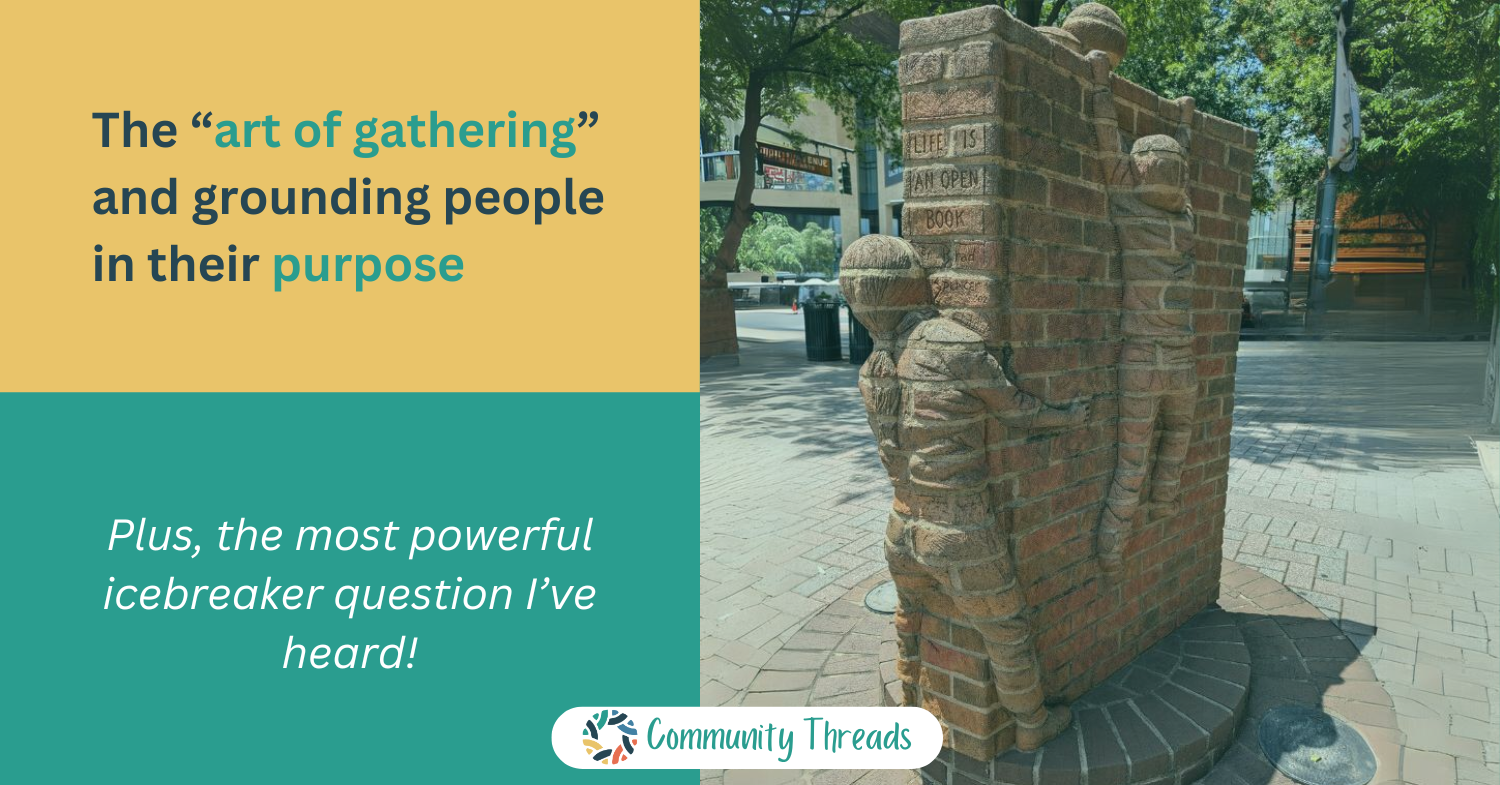
Speaking of thought-provoking openers - while I was in Charlotte for this meeting, I wandered through the city and checked out the amazing public art sprinkled throughout, and this sculpture at the entrance to a park really caught my fancy, so I had to take a quick picture. What a way to invite people to think about their time in this outdoor gathering space.

“Life is an Open Book” by Brad Spencer in The Green, Charlotte, North Carolina
Every time we come together with others, whatever shape or form that takes, however casual or formal, we have an opportunity to elevate that gathering - from something mundane to something extraordinary. Take your shot. And shoot me a note to tell me all about it!
Sign up to receive future newsletters directly in your inbox at www.pophealthllc.com!

HOW to put community voices in the driver’s seat
Are you ever told to do something and find yourself wondering, “Yes, but HOW?”
With PoP Health’s 2024 newsletter series, we want to be sure to at least begin to answer that question. For each phase of our C.A.P.E. process that we introduce, we’ll have an initial post orienting us to the topic and a second post that answers the “Yes, but HOW?” question.
Are you ever told to do something and find yourself wondering, “Yes, but HOW?”
With PoP Health’s 2024 newsletter series, we want to be sure to at least begin to answer that question. For each phase of our C.A.P.E. process that we introduce, we’ll have an initial post orienting us to the topic and a second post that answers the “Yes, but HOW?” question.
So earlier this month, we introduced the first phase of our C.A.P.E. process, Community Collaboration, with a focus specifically on collaboration with community members (see issue here). Today, we’re here to share a set of FAQs that dive into tips, strategies, and resources about how to do this work and put community voices in the driver’s seat.
Can you share some tips for collaborating with community members?
Community voice isn’t enough if we merely hear it, but don’t listen to and act on it: Have a plan in place and hold yourself accountable to what you will DO based on what community members have to say.
Community members’ time is precious - treat it that way:
Don’t make community members repeat themselves - gather all the community input that’s already been collected in the community, including by other organizations and groups, and make sure you 1) learn from what’s already collected and 2) avoid duplicating what’s already collected.
Don’t make community members come to yet another meeting if it’s not necessary - there are likely dozens of community groups already gathering regularly that talk about the topics you’re exploring, so reach out to them, see if you can attend their meetings, listen, take notes, and let that information drive your planning process.
Don’t make community members share their time and expertise for free - compensate them. But remember that financial compensation is only one piece of the puzzle - to treat community members’ time as precious, you need to actually act on what you hear from them.
Build lasting, trusting, mutual relationships with community members:
Don’t be a fair weather friend - have a sustained presence in the community and continue to get to know and work together with community members, don’t reach out just when you need something from them.
Build collective capacity of the community - consider how to build on existing strengths and assets of the community and help community members build their own capacity and power - financial, political, and otherwise.
What are some specific strategies for collaborating with community members?
Focus the conversation through Focus Groups in a Box. Those best equipped to gather input from community members are the leaders and organizations that community members already trust and go to for support. If you want your work to be driven by the perspectives and experiences of community members, and the specific information you're seeking hasn’t already been collected in the community, consider awarding small research grants to community partners that are already gathering places for community members, so they can lead their own focus groups. Develop a standard focus group guide and reporting template to share with them, so they can lead conversations using the guide and report back what they hear using the reporting template.
In PoP Health’s work with the Allegheny County Infant Health Equity Coalition, our client Healthy Start Pittsburgh awarded these research grants, and PoP Health developed the standardized focus group guide and reporting template that was shared with grantees. The information we gathered through this process is directly reflected in the resulting action plan. This approach checked a bunch of boxes: we put the power in the hands of community members (they led the groups and were compensated for their time), we met community members where they already were, we heard from dozens of additional marginalized community members that we wouldn’t have reached otherwise, and we got meaningful feedback that could be incorporated directly into the plan. So many wins.
Share data and drive prioritization via Data Walks. We are huge advocates of taking a data-driven approach to community health improvement. But data does not live in a vacuum - it is only in interpreting data that we can inform efforts to transform health in our communities. And the question becomes - who is interpreting the data? It is vital that community members have an opportunity to review, understand, interpret, and utilize data about their own community. One way to do this is via data walks.
In PoP Health’s work with the Partnership for a Healthier Fairfax and the Fairfax County Health Department, we will be helping synthesize insights from a series of data walks the health department is conducting with community groups across the County. During the data walks, community data will be shared directly with community members in a visual, easily digestible form. Their reflections and thoughts on what's most in important will directly feed into the prioritization process used to identify priorities for the county's community health improvement plan.
Widen your reach with Street Stalls. Community led focus groups and data walks are great, but here's the thing - only a certain type of community member is already active in existing organizations or likely to come to an event like a data walk. There’s another type - actually many types - of community members that won’t. And sometimes - scratch that, most of the time - those are the folks we most need to hear from. Knocking door to door isn’t typically an option, but what we can do is gather community input on-site at community locations and events (think community centers, recreation centers, festivals, farmer’s markets).
PoP Health used this approach to gather input to inform the Children’s Behavioral Health Blueprint led by Healthy Minds Fairfax. With a simple tri-fold poster board (don’t underestimate the low-tech options!), a list of resources to vote on (using sticky dots) to indicate what they found most helpful, and an open-ended question to respond to (with post-it-notes and markers), we got helpful input from a wider range of community members and not just those that would self-select into completing a survey or participating in a focus group.
What are some resources to help me collaborate with community members?
Here are just a few examples of resources we here at PoP Health have personally found helpful in our work. This is by no means a comprehensive list - please email us to share other resources and tools you’ve found helpful in collaborating with community members!
Facilitating Power’s The Spectrum of Community Engagement to Ownership
The National Association of City and County Health Officials’ (NACCHO’s) Mobilizing for Action Through Planning and Partnership 2.0 resources, especially the Power Primer supplement
Human Impact Partners’ (HIP’s) Resources for Collaboration and Power Sharing and Activities to Deepen Your Power-Building Analysis
We hope these tips, strategies, and resources help begin to paint a picture of HOW to collaborate with community members and place more power in their hands.
It’s not a straightforward process, and if you’re anything like me, Reader, you’ll make plenty of mistakes along the way. But it’s absolutely vital and unquestionably worth it - we can’t transform health in our community without community members in the driver’s seat.
Sign up to receive future newsletters directly in your inbox at www.pophealthllc.com!

Putting community voices in the driver’s seat
In this post, we’ll dive into the first phase of our C.A.P.E. process: Community Collaboration.
This month, we’re going to focus specifically on collaboration with community members - today, we’ll get oriented to what we mean by that and in a couple weeks, we’ll walk through some specific strategies in this arena.
Without further ado, let’s get into it - FAQ style.
In this post, we’ll dive into the first phase of our C.A.P.E. process: Community Collaboration.
This month, we’re going to focus specifically on collaboration with community members - today, we’ll get oriented to what we mean by that and in a couple weeks, we’ll walk through some specific strategies in this arena.
Without further ado, let’s get into it - FAQ style.
What do you mean by collaborating with community members?
I like the idea of collaborating with community members instead of “engaging” them or “empowering” them.
Community engagement sometimes gets misinterpreted to include any superficial/half-hearted effort - what I call the “We talked to that one community member once and asked them leading questions so they could confirm what we already decided to do” approach. As my three year old has recently taken to saying (in response to just about everything) - no, thank you.
Community empowerment suggests we are giving power to community members. But we do not empower communities, they empower themselves.
Instead, we use the term community collaboration to capture a meaningful effort to listen deeply, put community voices in the driver’s seat, and actually take what we learn from listening to community members and work with them to act on it and make changes.
Listening is vital, but we can’t stop there.
What are some ways to think about how we collaborate with community members?
I love a good framework, and in the arena of collaborating with community members, “The Spectrum of Community Engagement to Ownership” (hat tip to Facilitating Power) is one of my go-tos. Community ownership moves beyond merely engaging the community to “foster[ing] democratic participation and equity through community-driven decision making”, helping bridge the gap between community and governance. We can’t get there in one fell swoop, but a step taken to move along this spectrum is a step in the right direction.

Source: Modified version of figure in The Spectrum of Community Engagement to Ownership by Facilitating Power
What questions should I be asking myself about how we collaborate with community members?
How long have we been a presence in the community? Have we built lasting, trusting, mutual relationships with community members? If not, how can we begin to take steps towards that?
Have we shown our respect for the voices and expertise of community members - by way of compensation, building from their existing strengths and assets, and ensuring they are driving the agenda and we are supporting them as opposed to vice versa?
What specific changes - to processes, decisions, investments, programs, policies, or systems - were made based on what community members had to say? What specific changes did we see in beliefs, behaviors, and health or other outcomes as a result?
What have we done to build collective capacity of the community, whether via training/capacity building activities, building political power, supporting mutual aid efforts, sharing financial ownership, or other means?
When you do this work well, you’ll feel the results. Have you had a community member tell you they feel heard and seen in your work? I can tell you from experience, it’s the best feeling. And more importantly, it’s the key to unlocking the kind of transformation we want to see in our communities.
Sign up to receive future newsletters directly in your inbox at www.pophealthllc.com!

A non-cringey survey that helps coalitions understand themselves
Today, I’m going to talk about surveys.
Does that make you cringe?
I understand if it does. Surveys get a bad rap.
We’re often trying to get participants in a program or members of a community to take a survey, and - often - we don’t provide enough context for them to buy into the value of the information they’re sharing or for them to believe any changes will result from their input. To be fair, and to make matters worse, oftentimes there aren’t changes made as a result of survey responses.
Today, I’m going to talk about surveys.
Does that make you cringe?
I understand if it does. Surveys get a bad rap.
We’re often trying to get participants in a program or members of a community to take a survey, and - often - we don’t provide enough context for them to buy into the value of the information they’re sharing or for them to believe any changes will result from their input. To be fair, and to make matters worse, oftentimes there aren’t changes made as a result of survey responses.
There is a time and place for participant/community surveys, we certainly use them in our work here at PoP Health, and we have some thoughts on how to make them less painful and more impactful - more to come on that in a later newsletter.
But today, I’m here to talk about a kind of survey that doesn’t have quite as many potential pitfalls. A non-cringey survey, if you will.
This is a survey that coalitions and collaboratives can use to reflect on themselves. For lack of a better name, we call them partnership surveys.
These surveys are solely for members of the coalition, and the results help coalition members understand who they are and what they bring to the table, where they already have a lot of energy and expertise to move things forward, and where they may have gaps that need to be filled.
As per the latest guidance from the National Association of City and County Health Officials (NACCHO)’s, by way of their Mobilizing Action through Planning and Partnerships 2.0 process, local health departments are encouraged to begin their community health improvement assessment process with exactly this kind of survey (they call it a Community Partners Assessment).
I mentioned this briefly in the last issue of Community Threads, but we used this kind of survey in advance of our kick-off meeting with the Perry County Health Coalition in Pennsylvania earlier this month. At the meeting, we shared the survey results - which painted a picture of:
Top action planning priorities;
What members hope to accomplish via participation in the coalition;
Current coalition composition, sectors and topics represented, populations touched by coalition member organizations, and suggestions around organizations, individuals, and communities to engage (either directly as coalition members or at other levels of engagement);
Alignment between member organization focus areas and focus areas identified in the 2022 health assessment the coalition completed;
Current and desired levels of engagement in the coalition;
Activities and tasks members are most interested in supporting;
Desired meeting format, frequency, and scheduling.
As you can imagine, by gathering this information ahead of the meeting and then sharing the synthesized responses and drawing out the key takeaways, we were able to facilitate a much more meaningful, nuanced discussion about where to go from here.
And since we were only surveying members of the coalition - who were already bought into the work of the coalition and wanted to actively use the results to inform their work - this survey rated pretty high on the non-cringey scale.
Have I convinced you that partnership surveys are non-cringey? Feel free to disagree with me (or share other examples of non-cringey surveys!) - drop me a line!
Sign up to receive future newsletters directly in your inbox at www.pophealthllc.com!

Leveraging the power of in-person gathering
I’ve been thinking a lot about the power of in-person gathering on the professional end as well. After a long summer vacation, this Fall has been a period of reconvening in person.
Last month, we had an in-person kick off for a DC School Behavioral Health Consortium that drove home the energy and sense of community that can come simply from sitting around the same table. I also loved the icebreaker the meeting conveners used to set the stage for our time together - they shared a collage of different images representing collaboration and asked each person, as we went around the room for introductions, to share which image resonated most with them and why. What a great way to orient the group to the reason we had come together and unearth some key distinctions and nuances in how each person at the table might approach this work. We’ve gotten used to “setting the stage” activities in virtual spaces, but they are just as valuable in in-person gatherings.
I’ve been thinking a lot about the power of in-person gathering on the professional end as well. After a long summer vacation, this Fall has been a period of reconvening in person.
Last month, we had an in-person kick off for a DC School Behavioral Health Consortium that drove home the energy and sense of community that can come simply from sitting around the same table. I also loved the icebreaker the meeting conveners used to set the stage for our time together - they shared a collage of different images representing collaboration and asked each person, as we went around the room for introductions, to share which image resonated most with them and why. What a great way to orient the group to the reason we had come together and unearth some key distinctions and nuances in how each person at the table might approach this work. We’ve gotten used to “setting the stage” activities in virtual spaces, but they are just as valuable in in-person gatherings.
Last week, we had our second annual set of Ignite presentations and data sensemaking sessions for our work (in partnership with the Center for Health and Healthcare in Schools at GW) as the Monitoring, Evaluation, and Learning partner for an antiracist, whole child development initiative in DC schools. Although this kind of sharing of our work and making sense of data visuals could, technically speaking, be done virtually, there is something about the power of being seated in a circle and lending our full attention to the discussion at hand that is hard to recreate on Zoom. There is also perhaps something even more powerful about the “sideline” conversations that occur between partner organizations during an in-person gathering, especially one that includes time to share meals together and catch up informally, as we did on both days of this convening. One of our partners emailed us after the event, “I wanted to thank you all for such an impactful convening this week. It was really inspiring to be around such a thoughtful group of educators/advocates and to be able to more deeply connect the dots across the entire project. I was even able to leave with immediate steps to further collaborate with [two of the other partner organizations on particular projects].” This is exactly what we hope can arise from bringing people together.
And finally, later this week, we are kicking off our partnership with the Perry County Health Coalition in Pennsylvania with an in-person convening of the coalition - the first time they’ll be gathering in person since 2019! So we’re trying to be thoughtful about how we make this brief time together as meaningful as possible. One thing we did is send around a survey and conduct a few interviews several weeks in advance of the meeting. We’ll be sharing our findings from the survey and interviews at the meeting as a launchpad for further discussion - this approach allows us to get the more obvious and consensus-y ideas shared quickly, leaving more of our precious in-person time to navigate the areas where there is complexity, uncertainty, or disagreement.
None of this is to say there is not unique power in virtual gathering - here at PoP Health, we love facilitating virtual convenings and have lots of tips and tools to make that time meaningful, engaging, and productive.
It’s just that this past month in particular, we’ve also been thinking a lot about the power of in-person gathering and how we can leverage that.
Reader, curious to hear your thoughts - in your experience, what’s the unique value-add of gathering in person? And how can we best leverage the power of those (sometimes rare) opportunities to be together in the same physical space? Drop me a note!
Sign up to receive future newsletters directly in your inbox at www.pophealthllc.com!

How to keep people engaged in community health improvement efforts
Have you ever struggled to keep people engaged in a community health improvement effort (or any effort, for that matter)?
I work with a lot of community coalitions and collaboratives, and most of them are volunteer-based, which makes this question of how to maintain engagement especially important. But even those that compensate their members for their involvement need to consider the question of how to keep people involved and inspired and motivated to participate and act in meaningful ways.
Have you ever struggled to keep people engaged in a community health improvement effort (or any effort, for that matter)?
I work with a lot of community coalitions and collaboratives, and most of them are volunteer-based, which makes this question of how to maintain engagement especially important. But even those that compensate their members for their involvement need to consider the question of how to keep people involved and inspired and motivated to participate and act in meaningful ways.
In my line of work, with public health focused coalitions, people are generally at the table because they care - they care about the health of the community and they want to help make it better. But there are so many services and supports to coordinate and so many partners to collaborate with; it’s hard to know where to start; and there is simply not enough time in the day, especially since most coalition members have their actual day jobs to do.
Whether you are recruiting members or trying to hold onto the ones you already have, what’s the secret to keeping folks engaged?
This week, I came across an interview with Arthur C. Brooks (a Harvard professor who studies, teaches, and writes about happiness) about “the secrets to happiness at work,” and I think it’s spot on and extremely relevant to this question of how we keep coalition members engaged in the work of the coalition.
Here’s what he says on this topic: “The two parts of work that really matter [for happiness at work] are not title, not money, not admiration, not power, [but] earned success and serving other people.”
Here’s how he describes these two concepts among workers: “They feel like they’re earning their success, which is to say that they’re creating value with their lives and with their work lives, that their accomplishments are moving the needle and they’re being recognized for those accomplishments. And number two, they feel like they’re serving people so that they’re needed.”
Do these two concepts resonate with you?
They did for me - when I think of the jobs I’ve been least satisfied with and the ones I’ve loved the most (including what I do now!), earned success and serving other people do seem like distinguishing factors.
In this interview, Brooks goes on to say, “The number one thing that you can do for recruitment, for retention, the ultimate rewards that go far beyond money are making sure that you have a system where people are earning their success through their merit and personal accomplishment. They know it, they see it, and so do their friends. And they actually feel like they’re serving other people and they can see the faces of the people for whom they’re creating value.”
And this, I think, is what community coalitions and collaboratives (and public health organizations and agencies more broadly) should be thinking about. How can we give people clear roles and responsibilities, where accomplishments they are striving for are clearly defined and celebrated once achieved? How can we make meaningful connections between the members/employees of our coalitions/organizations and the community members we serve, so the value we’re creating can be truly seen and felt?
These are the questions I leave you with today- I would love to hear your thoughts!
Sign up to receive future newsletters directly in your inbox at www.pophealthllc.com!