

Why most coalitions feel stuck in neutral (and the key to shifting gears)
For the last few months, we’ve been talking about how public health isn’t actually a systems business. It’s a people business.
For the last few months, we’ve been talking about how public health isn’t actually a systems business. It’s a people business.
If you missed our series on this, or are just joining us (welcome!), definitely circle back and check it out. We talked about why I think public health is a people business (despite being a HUGE believer in systems change), the one thing it all comes down to, why you need champions, the biggest threat to sustaining your coalition’s work, and why the key to your coalition’s success is to be human (yes, even in - especially in - a world obsessed with AI).
Health coalitions and other partnerships are a prime example of public health as a people business. Yes, our aim is to change systems (not people), but to get to systems change, we have to inspire, coordinate, and mobilize our coalition and community members to act, and we have to listen to and learn from them along the way.
If you’ve ever felt STUCK in neutral in your coalition - stuck in the “ sit and meet with people” phase, stuck in the “let’s do another needs assessment” phase, stuck in the “we have a strategic plan but it’s sitting on a shelf phase” - then the key to shifting gears has to do with building a foundation that recognizes this PEOPLE component of the work.
Who you have at the table, how you listen to and co-create with them, how you inspire them, how you decide what to do together, how you build their capacity - all of this matters deeply.
Without it, you lack engagement, you lose momentum, you remain stuck in neutral.
With it, you build the foundation you need to shift gears and get to meaningful action and lasting impact.
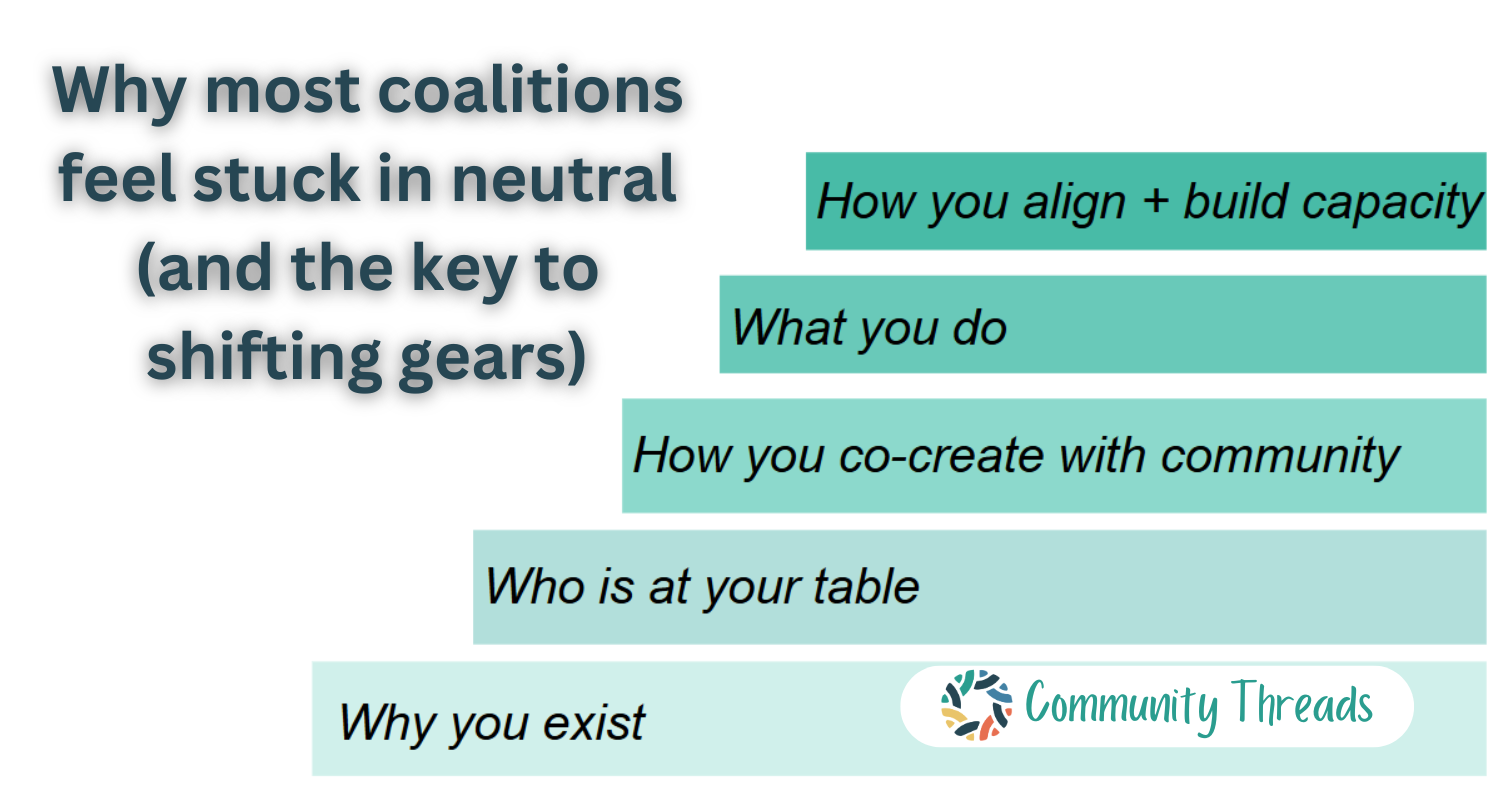
I recently gave a talk at the National Network of Public Health Institutes conference where I shared the steps involved in this foundation. We call it the Coalition Core 5 and it’s the difference between a coalition feeling stuck and feeling like a superhero, between admiring the problem and solving it, between feeling stalled and having real momentum and impact.
Here are the five steps:
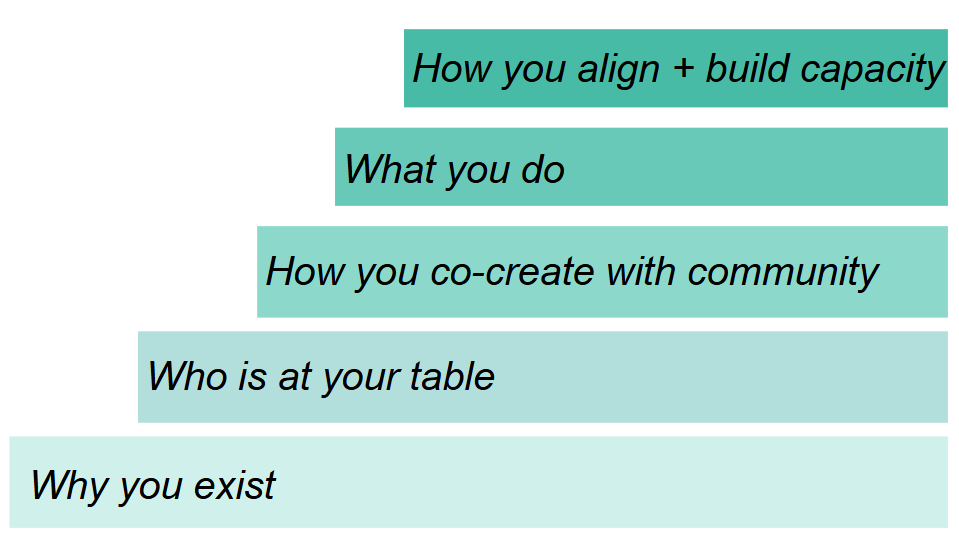
Over the next several issues, we’ll unpack each of these steps, sharing how we’ve helped our partners use them to shift from neutral into high gear.
But first, I’d love to hear your initial reaction. Which of these steps sounds most promising to you in terms of unlocking greater engagement and impact in your coalition? Drop me a note and let me know!
***
P.S. Sometimes it helps to just say the challenges out loud. If you're looking for a fresh perspective on what’s next for your health coalition, you can find my calendar here.
And if you're looking to share this newsletter with another coalition member or colleague, here's the link to subscribe.
***
Sign up to receive future newsletters directly in your inbox at www.pophealthllc.com/newsletter.
In a world of bots, be a HUMAN - it’s key to your coalition’s success
As we’re highlighting through this series, public health is, at its core, a people business.
So, naturally, one key piece of advice for health coalition leaders to keep in mind: Be a human.
In an era of artificial intelligence and soulless corporations, there’s something to be said for simply being human.
As we’re highlighting through this series, public health is, at its core, a people business.
So, naturally, one key piece of advice for health coalition leaders to keep in mind: Be a human.
In an era of artificial intelligence and soulless corporations, there’s something to be said for simply being human.
And even for those of us who are devoted to transforming health and well-being in our communities, it’s easy to lose sight of the ways in which being human makes our work stronger.
So we’re going to shine a light on a few of those ways. Here’s how you can lead with your humanity:
1. Lead with YOUR story.
Don’t just embrace your humanity, lead with it. Get personal.
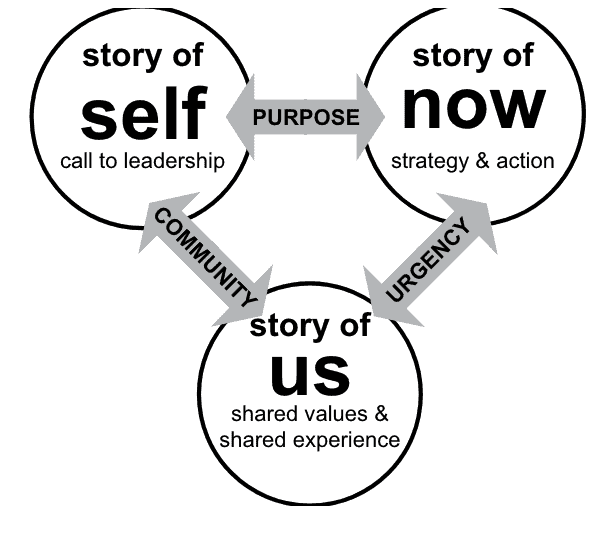
We love Marshall Ganz’s Public Narrative framework (ever since I first learned this from him in a grad school class, it completely reshaped the way I approach storytelling).
Instead of a dry bio, frame your communication through three lenses:
The Story of Self: Why are you called to this work? What specific experiences shaped your values?
The Story of Us: What shared values and experiences connect your coalition members? Your community members?
The Story of Now: What is the urgent challenge we face, and what is the specific path forward?
2. Embrace JOY.
Yes, things are heavy in the world and in our country right now. Yes, public health has been attacked right and left. And yet - we cannot forget the human desire for JOY.
If your coalition meetings feel like a chore, people will eventually stop showing up. Find ways to infuse delight into the process - a funny icebreaker, a celebration of small wins, space for connection. If people are having fun, they’ll stay in the fight - and so will you.
3. APOLOGIZE.
We are human. We’re going to make mistakes. In a professional world that sees admitting fault as a liability, be the person who owns it.
When you make a mistake, acknowledge it. Apologize. Rewind and/or repair. When you fail to acknowledge a mistake, you lose credibility. When you own it and take action to make things better, you gain trust.
4. Prioritize COMMUNITY.
“Community is the medicine.” Every single line of this convocation speech Lily Singh gave is so on point. She says: “Everything is better when it happens alongside people you love. Though the world is trying to convince you otherwise, we are all wired for togetherness…Human connection is the entire point.”
Ok, take a look back at that list. Can AI meaningfully do these things? Can a soulless corporation?
I don't think so.
So don’t shy away from being YOU - flawed, excitable, vulnerable, real, HUMAN.
Transforming community health is a people business. The only way to succeed is to be human.
What do you think? How are you bringing your human self to your coalition meetings this week?
***
Sometimes it helps to just say the challenges out loud. If you're looking for a fresh perspective on what’s next for your health coalition, you can find my calendar here.
Sign up to receive future newsletters directly in your inbox at www.pophealthllc.com/newsletter.
The “rockstar” trap - the biggest threat to sustaining your coalition’s work
My first full time public health job was at a state health department, working with schools to implement evidence based youth violence prevention programs. Principals and school counselors were often the rockstars behind this work - until they weren’t.
My first full time public health job was at a state health department, working with schools to implement evidence based youth violence prevention programs. Principals and school counselors were often the rockstars behind this work - until they weren’t.
I repeatedly heard counselors say: “The program was a huge success…and then our principal left.”
Then I heard principals say: “The program was a huge success…and then our school counselor left.”
Here's the thing: No matter how brilliant your program or policy is, if it relies on the passion or knowhow of a single person, it’s designed to fail.
The “Rockstar” Trap
In health coalition work, we often rely on "rockstars,” those high-energy leaders and members who carry the institutional memory in their heads and the key relationships in their personal cell phones.
But hoping these rockstars stick around forever isn’t a strategy.
People get promoted. They get sick. They move. Especially in a volunteer-heavy environment like many coalitions are, turnover isn't just possible, it’s inevitable.
If your coalition's success depends on a specific person sticking around forever, you aren't building a movement to transform health in your community, you're hosting a temporary project.
To sustain your coalition’s work and impact, we have to go from relying on rockstars to building systems for succession.
What does this look like in practice? Let’s get into it.
4 Strategies for Succession Planning
Build a “Leadership Bench”. The first step here is to broaden buy-in and foster champions, as discussed earlier in this newsletter series - this way, the passion to keep the work going and the knowledge of how to do the work doesn't just live in one person AND you have a bench of people who are more ready to take on leadership roles when the time comes. To really build that bench though, you need to pair those broader efforts with a more focused succession planning approach. This brief (from the Association of State and Territorial Health Officials (ASTHO)) on demystifying succession planning in public health agencies can be a helpful place to start. While not specific to coalitions, many of the concepts are still relevant! They define succession planning as “a developmental strategy that equips staff with mentorship and training to grow into a future role when it becomes available. Rather than naming a backup, succession planning fosters a transparent pipeline for growth into a vertical or lateral position change. Stretch-opportunities and cross-training drive the preparation process.”
Kill the “Internal Rolodex”. Track and transition relationships, just as you would specific activities. Work moves at the speed of trust, and that is especially true when we’re talking about the work of community coalitions. So many relationships are needed to move the work forward - relationships with local policymakers and journalists, school system and faith-based leaders, community leaders and advocates. And if one person’s relationships live only in their internal rolodex, when they leave, those relationships vanish, and the work slows. Instead, track relationships in your project management system (which might just be a spreadsheet - that works!), along with pertinent details and notes, and when someone is leaving the coalition, make sure their relationships are transitioned too, not just their duties. Ideally, that can happen with a warm hand-off during a joint meeting (especially for really important relationships) but even in the absence of that, an email introduction or a link to where relationships are tracked in the project management system can go a long way.
Standardize the “Brain Dump”. Establish systems that ensure institutional history and knowledge are captured - ideally in real time - so that this information doesn't disappear when a person leaves. So often, our most passionate and effective leaders and members hold so much in their heads, and without the systems to document and share it, this vital information walks out the door when they do. Establish ‘Standard Operating Procedure’ (SOP) documentation processes, have a clear file organization system in a shared drive, use a project management tool to outline and track workplans, and make sure multiple coalition members are trained to know where to find these things, understand how they are set up, and are able to update them as needed.
Templatize the Transition: Have templates for transition documents so the person leaving has a clear roadmap of what to brain dump and document. The more of this that can happen in real time (as noted in the point above), the better, but there will always be loose ends. Make sure you have a place to capture them.
As we’re highlighting through this series, public health is a PEOPLE business.
But for our work to thrive, it cannot be dependent on the same people forever.
Whether it's the leader whose buy-in is a prerequisite for the work to move forward or the ground-level staff making it happen, plan for succession so you can sustain your work, maintain momentum, and continue to have impact in your community.
It’s the only to make sure that even when your rockstars (or you!) leave, the mission stays.
I'd love to hear from you - which of these strategies is your coalition or organization using well and where might you need to focus more?
Sign up to receive future newsletters directly in your inbox at www.pophealthllc.com/newsletter.
Why you need champions (not the Super Bowl kind)
How would you define a champion?
You might think about a Super Bowl or Olympic champion - that would be dictionary definition #1 (“someone or something, especially a person or animal, that has beaten all other competitors in a competition”).
But I’m thinking about dictionary definition #2: “a person who enthusiastically supports, defends, or fights for a person, belief, right, or principle”
How would you define a champion?
You might think about a Super Bowl or Olympic champion - that would be dictionary definition #1 (“someone or something, especially a person or animal, that has beaten all other competitors in a competition”).
But I’m thinking about dictionary definition #2: “a person who enthusiastically supports, defends, or fights for a person, belief, right, or principle”
We saw Bad Bunny champion community and love and unity during this year’s Super Bowl halftime show, not to mention Puerto Rico and Spanish and Latino heritage and culture.
We need those kinds of champions in this country right now.
And we need champions in our own coalitions and communities too.
Here’s the thing, as is the crux of this series of our newsletter, systems only change when people change.
And you can’t get people to change at scale without champions - people within their organizations and communities who proactively advocate for the change, support the change, model the change.
One of my favorite examples of this comes from our work in DC public schools. DC public schools launched a whole child focused initiative a few years ago, and they intentionally identified “champions” - teachers and staff in schools across the district who were going to champion this whole child work and be the early adopters, the vocal advocates, the guides, the role models.
When someone in a school saw a fellow teacher in their same building applying a new practice and sharing how much it helped them and their students, they were far more likely to want to try the practice themselves. And when they ran into challenges, they could run down the hall and get some advice.
Anytime your coalition is trying to shift a system, think about the people who need to be a part of the shift and who your champions are or could be. Nurturing those champions is a vital element of getting to the change you seek.
The idea of champions applies internally within coalitions too. Does it feel like your coalition is undervaluing something of importance (whether that be community voice or strategic planning or collective action or evaluation and learning or something else)? Who on your coalition already believes in the value of that thing and can you nurture them to be a champion and voice for that thing so other coalition members get bought in too?
Who are your champions - in your coalition, in your organization, in your community? What have you done (or could you do) to foster them as champions and accelerate the people change you need to get to systems change? Please reply and share your thoughts with me!
Sign up to receive future newsletters directly in your inbox at www.pophealthllc.com/newsletter.
It all comes down to one thing: buy-in
Turns out the answer to everything isn’t 42. Or 6-7 for that matter (sorry, I couldn’t help myself!).
It’s BUY IN.
Turns out the answer to everything isn’t 42. Or 6-7 for that matter (sorry, I couldn’t help myself!).
It’s BUY IN.
Okay, maybe not the answer to everything but in the world of coalitions, it IS the answer to a lot of questions:
Q: How do we get more things done?
A: Buy-in.
Q: How do we get coalition members to participate meaningfully in our meetings?
A: Buy-in.
Q: How do we get local policymakers to make the changes our community needs?
A: Buy-in.
Q: How do we get new leadership to carry on the work we’ve started?
A: Buy-in.
Q: How do we get an organization’s staff to take action on the things our coalition has identified as helpful?
A: Buy-in.
As we noted earlier this month and as is the focus of this series, public health is a PEOPLE business. And for any of the work to move forward, PEOPLE have to be bought in to the work.
What people? It’s a long list: coalition members, local policymakers, community agencies and organizations (their leaders and their staff), community members themselves.
Which of these people really need to be bought in to a specific aspect of the work will vary based on their level of involvement and the stage of the work, but at some point, each of their buy-in will be important to advancing the work of your coalition.
So how do you get buy-in? Here are four steps to follow:
Whoever you need buy-in from, understand their ‘why’ - What do they most need and want? What motivates them and inspires them? What keeps them going? What keeps them up at night? What are their priorities and values? What metrics are they held accountable to?
Frame what you’re seeking in those terms - I’m not saying pander or change your goals (although sometimes, changing goals makes sense based on the input you get!). Rather, try to frame what you’re seeking in terms that align with their ‘why’ and understand what language to let go of and what language to amplify.
Bring them along for the ride - It’s hard to feel bought in to something if it’s been shaped without your input and now being forced on you. Understand who you need buy-in from and bring them along from the get-go. Involve them in shaping the work (This doesn’t mean you act on everything they say! But it’s important to hear them and be open to reshaping the work in ways that balance your ultimate goals and the needs and realities of those you need buy-in from to accomplish those goals).
Tell the story of how what you’re seeking is going to help them - How does what you’re seeking align with what they need and want, take something off their plate, help them achieve a goal, alleviate one of their pain points, or strengthen their impact?
Building buy-in is one of the most important roles of coalition leadership. I’d love to hear more about your experiences building buy-in. Whose buy in do you need that has been hardest to get? Is there a particular approach or conversation that has really worked for you in gaining buy-in? Drop me a note and let me know!
Sign up to receive future newsletters directly in your inbox at www.pophealthllc.com/newsletter.
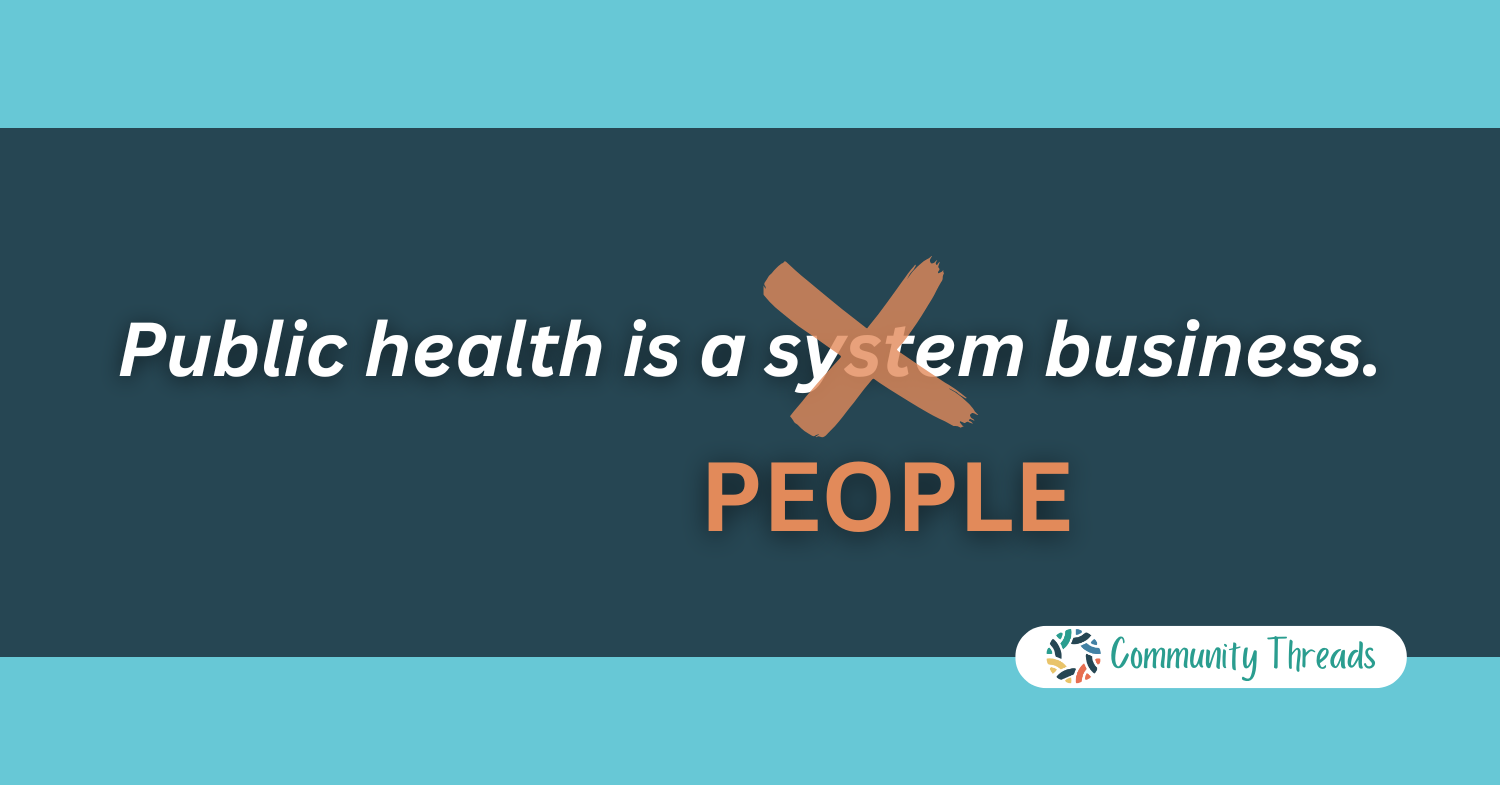
Public health isn't a systems business
It might not be something you’d expect me to say - me, someone who has drunk the “systems change” Kool-aid from way back in my undergrad engineering days throughout my public health training and into launching PoP Health (where our entire mission is to work with community coalitions to transform health through systems change).
Well, did that title catch you off guard?
It might not be something you’d expect me to say - me, someone who has drunk the “systems change” Kool-aid from way back in my undergrad engineering days throughout my public health training and into launching PoP Health (where our entire mission is to work with community coalitions to transform health through systems change).
But at a conference a few months ago, I heard someone say something that has really stuck with me because of how unexpected yet true it is: Public health is a people business cleverly disguised as a systems business.
Systems only move when PEOPLE move. So as leaders of community coalitions, we all need to build our PEOPLE strategy, not just our systems change strategy.
This is why we’re heading into 2026 with a new special series of Community Threads, focused on public health as a people business.
Because systems don’t change if people aren’t bought in.
Because systems don’t change if people aren’t champions for that change.
Because systems don’t change if we don’t plan for people moving into and out of leadership.
Because systems don’t change if we don’t treat people like people.
Because systems don’t change if we aren’t real with people.
We’ll be sharing more on each of these points over the next couple months. Please join the conversation, and forward this on to friends and colleagues - especially those who lead community coalitions! - who might be interested (if you got this email forwarded to you, you can subscribe to Community Threads here so you don’t miss getting this series straight to your inbox!).
What do you think? In what ways do you see public health as a people business? In what ways do you see public health as a systems business? Drop me a note and let me know!
Sign up to receive future newsletters directly in your inbox at www.pophealthllc.com!

HOW to tell a powerful story + tips to transport and activate your audience
I’ve been leaning on beach reads this summer (to be honest, I lean on them year-round) and have always loved being transported to new places through stories.
But let’s be real, it’s easy to transport a reader to a beautiful beach on vacation. It’s a lot harder to transport them into, say, the lives of families in rural America.
I’ve been leaning on beach reads this summer (to be honest, I lean on them year-round) and have always loved being transported to new places through stories.
But let’s be real, it’s easy to transport a reader to a beautiful beach on vacation. It’s a lot harder to transport them into, say, the lives of families in rural America.
But even stories about the same place and same community can be quite different from one another.
As J.D. Vance hits the news cycle as the Republican vice presidential nominee, I’ve been thinking a lot about an alternative to his Hillbilly Elegy (a memoir about life in rural America, which I did not read) - namely, Demon Copperhead by Barbara Kingsolver (a novel about life in rural Appalachia, which I read and found deeply moving).
Hillbilly Elegy (although it received critical acclaim from many upon release) has been described as condescending and inauthentic. I suspect the reason for this is the nature of the stories the book tells. As one Appalachian Studies expert put it, “One of the most troubling things to me about the book is that it talks a lot about unemployment and poverty, domestic violence, the opioid crisis, but it never gives you context for why those things exist the way they do in Appalachia.”
In contrast, one journalist notes, “Kingsolver slyly weaves the history of her home into Demon’s harrowing tale. From the Whiskey Rebellion to the boom and bust of the tobacco and coal industries, she describes a community preyed on for decades as governments and companies extracted their resources. And then came the opioid crisis.”
If you haven’t read Demon Copperhead yet, pick it up now - it’ll show you the power of story in transporting us much better than I can. But you know me, I’m going to try anyway! Here are some tips, strategies, and resources for transporting and activating your audience via powerful storytelling.
Can you share some tips for effective storytelling?
Storyboard. I have loved Echo Rivera’s trainings around presentations (which are, after all, simply a story you’re telling!) and one thing she emphasizes is that Step 1 is storyboarding. You have to map out the flow of the story you’re telling from the get-go and make sure it’s going to leave the audience with the right takeaways. So don’t jump to writing, slide creation, or anything else until you’ve taken the time to storyboard.
Get personal. Here at PoP Health, we’ve been working on a project for the Centers for Disease Control and Prevention focused on how to improve public health cancer prevention messaging and one of our key takeaways has been the need to get more personal. What does this look like? It’s not about dry facts or abstract concepts. Instead, think personal true stories from “people like me” that are accompanied by the faces of those people, embedding health information in TV shows, appealing to one’s identity (tapping into a shared identity of being a mom, encouraging kids to “be a helper” instead of “help others”).
Be relatable. Use words your audience would use. Use metaphors to help boil down complex concepts into something your audience can wrap their arms around. Keep it local.
Get visual. Drawings, photos, videos, GIFs, all can be helpful, especially when they feature real people, make your audience laugh, or convey a powerful message. Infographics and data visualization - when done well - are also great tools.
What are some specific strategies for effective storytelling?
Co-create stories and messages: You know who already knows the real stories that will resonate with your audience? The people who’ve lived those stories. Also known as your audience. Co-create stories and messages with them.
Interpret your data for your audience: Use a storytelling sentence. Don’t leave it to chance or someone else’s interpretation. Don't assume the numbers speak for themselves. It's your story - so, tell it! Along the same lines, take this great advice from Stephanie Evergreen and make your data dashboard a webpage. Why? Because then, you’ll be telling an actual story! And as Stephanie says, “That narrative is where you get nuance. Expansion. Explanation. Clarification.”
Tailor content: First, you need to tailor content to your audience (based on a wide range of factors that are too much to get into here - more to come on that in the future), to the channel you’re using (please don’t post your static flier content to Tik Tok or vice versa!), and to the current and local contexts. Also tailor content to the type of deliverable (Website? Report? Social media post? Podcast?) and tailor the deliverable you’re choosing to work for your particular goals and audience. Even within a single deliverable, try to make it modular, so you can easily toggle in and out “modules” for different audiences based on who needs X background information or who cares about Y data.
What are some resources to help me tell powerful stories?
Echo Rivera’s free 6 Gears of Creating Engaging Presentations training
Stephanie Evergreen’s “delightful, strategy shifting, and totally free ideas for your next data viz”
Potential Energy Coalition’s Talk Like a Human guide (I think their lessons on how to communicate climate change apply much, much more broadly!)
Here’s the thing, effectively sharing what we know, do, and learn is essential to transforming health in our communities. And there is no better way to do that than to tell stories. So embrace your identity as a storyteller and get REALLY good at it - the results will surprise you.
Sign up to receive future newsletters directly in your inbox at www.pophealthllc.com!

Why people forget facts but remember stories - an intro to Effective Storytelling
Is your summer off to as hot and joyful a start as mine, Reader?
Our family spent the last week at an all-family violin camp in the Blue Ridge mountains, and it was a joy on so many levels (our girls did not want to come home!).
Being surrounded by music all week had me forgetting the heat (despite the lack of AC at camp) and remembering just how powerful art is and how every piece of art tells a story.
Have you heard the quote about how people forget facts but remember stories? That's definitely true but misses a key piece of the puzzle. People remember stories because they make them FEEL.
Is your summer off to as hot and joyful a start as mine, Reader?
Our family spent the last week at an all-family violin camp in the Blue Ridge mountains, and it was a joy on so many levels (our girls did not want to come home!).
Being surrounded by music all week had me forgetting the heat (despite the lack of AC at camp) and remembering just how powerful art is and how every piece of art tells a story.
Have you heard the quote about how people forget facts but remember stories? That's definitely true but misses a key piece of the puzzle. People remember stories because they make them FEEL.
Which brings me to another quote, this from Maya Angelou: “People will forget what you said. People will forget what you did. But people will never forget how you made them feel.”
I have always been moved by stories in all their forms - as an avid reader of novels, as a dancer, as a journalist through middle/high school and college, as a mom (and chief bedtime book reader).
I’ve written about the power of narrative and why we need to tell more stories before, so today I’m especially excited today to dive into the final phase of PoP Health’s CAPE process - Effective storytelling.
What do you mean by effective storytelling?
Coalitions and collaboratives working to transform health in their communities need to tell their stories - stories of their communities, their work, their process, their successes, their impact, and also their struggles and the barriers that prevent them from having more impact.
They need to tell their stories with and to community members; they need to recount their stories to policymakers and funders; they need to share their stories with partner organizations and agencies.
Effectively sharing what we know, do, and learn is essential to community health improvement. Elevating the voices of community and coalition members through these stories and synthesizing your experiences and learnings in ways that resonate with community members, policymakers, funders, and other key audiences are not easy tasks - but they are vital.
What are some ways to think about effective storytelling?
There are many storytelling frameworks to choose from, from the Hero’s Journey to the Freytag Pyramid to the Pixar Story Framework.
They all have helpful components and are worth exploring. What might be even more helpful as a starting point, though, are these two highly simplified models of storytelling:
Hook / Story / Close: This is pretty much just what it sounds like. You start with a powerful hook that captures your audience’s attention, tell a compelling story, and close with a call to action or an offer. Each component might be quite different based on your audience (what hooks a policymaker won’t hook a community member and what you want a funder to do is likely quite different than what you want a partner organization to do).
The Golden Circle: Simon Sinek’s idea of a Golden Circle, popularized via his 2009 TED Talk, captures how inspiring organizations and individuals think, act, and communicate: They start with explaining why (what’s the purpose, cause, or belief?), then how (how is the why brought to life?), and only then the what.
While we’ve been focusing on storytelling, it’s not just about the story! Who’s telling it, who’s hearing it, the channel through which they’re hearing it, how they respond, the broader context, misinformation - all of these things matter, and they can matter quite a lot. In a current project focused on strengthening cancer prevention communications, we’ve been using this communications framework to organize our findings, and I find it quite helpful:
Eight Essential Components of Communication:
Source: Who’s creating and sharing the message?
Message: What are they saying?
Channel: How is the message traveling between source and receiver?
Receiver: Who’s receiving the message from the source?
Feedback: What messages does the receiver send back to the source?
Environment: What’s the surrounding physical and psychological context where messages are being sent and received?
Context: What’s the broader setting and scene, and what supports/barriers does the receiver face in acting on the message?
Interference: What blocks or changes the source’s intended meaning of messages, including misinformation and disinformation?
What are some questions I should be asking myself about effective storytelling?
How can we elevate and center the voices of community and coalition members in our stories, and who among them will our audiences most deeply connect with?
How can we transport our audiences through story (given that narrative transportation reduces psychological barriers, serving as a powerful tool for persuasion) and tap into their self-concept/self-identity - their sense of who they are as a person (given that people engage with communications that deepen their sense of self and reject communications that counter their sense of self)?
Where and how can we best reach our audiences?
What supports or hinders our audience from acting on what we tell them, and how can we address these factors?
Sometimes, we’re so tired doing the work that we don’t take the time to tell our story - much less tell it well. But it’s a vital part of the process of transforming health in our communities.
Sign up to receive future newsletters directly in your inbox at www.pophealthllc.com!

A Participatory Evaluation HOW TO: tips and tools for sensemaking, storytelling, and more
It was college reunion weekend at my alma mater (wahoowa!), and in addition to taking a few (literal) walks down memory lane, I thought a lot about feeling a sense of community and what magic combination of ingredients is needed to create that.
Shared experiences - especially those where you gain something of value and even more so those where you create something of value - are part of that secret sauce.
And participatory evaluation, when done well, checks all those boxes.
It was college reunion weekend at my alma mater (wahoowa!), and in addition to taking a few (literal) walks down memory lane, I thought a lot about feeling a sense of community and what magic combination of ingredients is needed to create that.
Shared experiences - especially those where you gain something of value and even more so those where you create something of value - are part of that secret sauce.
And participatory evaluation, when done well, checks all those boxes.
If you missed the last issue of Community Threads, be sure to check it out first, as it provides an overview of PoP Health’s participatory evaluation approach. With that approach in mind, today’s issue is diving into HOW we actually do participatory evaluation. Let's jump right in.
Can you share some tips for participatory evaluation?
Begin with the end goal in mind, and design your evaluation and learning process accordingly. What do community members, coalition members, and the evaluation and learning team most want to learn and why?
Consider how community members can co-own - and meaningfully benefit - from every stage of the evaluation and learning process, from initial brainstorming and planning through data collection and analysis through sensemaking and storytelling. How is each stage of the process structured to allow community members to drive or co-lead the process? How is each stage of the process designed to ensure community members walk away with new capacity, connections, resources, and supports?
Develop infrastructure for responsive feedback and continuous quality improvement. You’ve heard this tip before from me and I'm repeating it here because it can't be overstated and hardly anyone truly does it! Yes, a key goal of evaluation is to understand impact but an equally if not more important goal is to improve the work. It's vital to set up infrastructure (time, resources, systems) from the outset so you are flexible and nimble enough to implement course corrections and improvements in real time based on analysis of monitoring data.
Diversify and tailor your evaluation deliverables, and make them modular where possible. Here is a slide from PoP Health’s Evaluation 101 workshop that includes a range of possible deliverables through which to share evaluation results and stories (and there are many more beyond what's listed here).

Don’t limit yourself here, get creative! Data dashboards are all the rage these days, but I love Stephanie Evergreen’s take on them, especially for something community facing - make it a webpage instead. You can also tailor content to different audiences - we often do this via briefs/two-pagers, one for community members, one for policymakers, one for funders, and so on. They each care about different things. We have also had success with making our briefs modular - having “modules” (short sections of the brief) that can be toggled in or out of a brief depending on who needs X background information or who cares about Y data.
What are some specific strategies for participatory evaluation?
There are many, but here are a few I especially appreciate for the meaningful role community and coalition members play:
Community based system dynamics modeling: A key part of evaluation and learning in public health is understanding dynamic, complex, messy systems. In the case of our work on school mental health in DC, students, family members, teachers, school administrators, policymakers, and others may have completely different understandings of the school mental health system. So we engaged in what’s called Community Based System Dynamics, in partnership with the Social System Dynamics Lab – this process uses participatory group model building approaches to explore the system in question. We held modeling workshops with students, with caregivers, with teachers, and with our multisector Stakeholder Learning Community. During the workshops, groups huddled around large sheets of paper, discussing, writing things down, crossing things out, drawing arrows, and so on. They produced a series of causal loop diagrams, which I then synthesized and integrated into this version of our systems map. Much more on this in a prior PoP Health newsletter here.

Data placemats for collective sensemaking: Community members and coalition members have experiences, expertise, and perspectives that lead them to insights your evaluation team, program team, and funders are apt to miss entirely. So don't make the mistake of leaving them out of the conversation. I love using highly visual data placemats and data posters to bring coalition members and community members into the process of making sense of data and drawing insights - about what we've learned so far, how to continually improve the initiatives we work on, and what other information we need to gather moving forward. We’ve recently used data placemats (during a coalition-wide data sensemaking session) and data posters (during a community-wide symposium) to share initial data from evaluation of the BIRTH Plan with our community and coalition partners in Pittsburgh, pairing the visuals with discussion questions that help elicit their thoughts on what they take away from the data, their insights about how to improve the work, and what additional information they’d most like to see in the future.
Sharing personal narratives: Nothing is quite as powerful as a story in someone’s own voice. Capturing personal narratives of community members/program participants/those influenced by a policy is a vital participatory evaluation strategy. In addition to focus groups and interviews, there are many creative ways to do this, including video journals, audio diaries, photo voice, and more. I especially love this idea of a participatory video process focused on stories of significant change. Participants are given the chance to take part in a Participatory Video process at baseline; stories of Most Significant Change are collected via structured story circles at midline; each circle selects one story to record on video. A participatory analysis identifies themes and recommendations. Given consent, videos can be shared so stakeholders learn directly from participants’ stories.
Community collaboration strategies: The community collaboration strategies we have featured previously (i.e., focus groups in a box, data walks, and street stalls) can also all be used in the context of evaluation and learning.
What are some resources to help me engage in participatory evaluation?
I’d like to leave you with a few resources I’ve found especially practical and useful in terms of participatory evaluation. As always, drop me a note to share other helpful resources or tools you’ve come across!
Participatory Evaluation: Theories + Methods for Remote Work(a guide I refer to regularly for meeting facilitation ideas, whether virtual or in-person!) from Evaluation + Learning Consulting
Community-Driven Data and Evaluation Strategies to Transform Power and Place (hot off the presses from Build Healthy Places)
Participatory Evaluation Toolkit from Health Nexus (which provides a great overview of 7+ specific techniques)
As always, we share these tips, strategies, and resources in the hopes that they help you understand HOW to engage in participatory evaluation.
Participatory evaluation is likely going to be messier, slower, and more expensive than more traditional evaluation approaches. But on the flip side… You’ll be driven by community. You’ll learn more. You’ll create greater and more sustained change in your community.
The pros definitely outweigh the cons in my book - what about for you?
Sign up to receive future newsletters directly in your inbox at www.pophealthllc.com!

The 'P' in our CAPE: Participatory Evaluation - by the community + for the community
A recent book club discussion about the challenge of adult friendships in the present day has had me thinking a lot about the importance of a sense of community.
On that note, a portion of a recent conversation between two of my favorite thinkers, Surgeon General Vivek Murthy and writer Anand Giridharadas, really struck me. Surgeon General Murthy shared that statistics show that people now are working more - “and parents are parenting more, even though they’re also working more.” He asks, “Where is that time coming from, that extra time? You put all this together and that time that is eroding is a time that we spend in person with family and friends, the time we spend for ourselves, and the time we spend for our communities.”
A recent book club discussion about the challenge of adult friendships in the present day has had me thinking a lot about the importance of a sense of community.
On that note, a portion of a recent conversation between two of my favorite thinkers, Surgeon General Vivek Murthy and writer Anand Giridharadas, really struck me. Surgeon General Murthy shared that statistics show that people now are working more - “and parents are parenting more, even though they’re also working more.” He asks, “Where is that time coming from, that extra time? You put all this together and that time that is eroding is a time that we spend in person with family and friends, the time we spend for ourselves, and the time we spend for our communities.”
On the heels of a community event I helped plan, I’ve also specifically been thinking a lot about what it means to do something “by the community, for the community” (our event tagline).
What does all this have to do with the focus of today’s newsletter, participatory evaluation (aka the ‘P’ in PoP Health’s CAPE)? Let’s get into it!
What do you mean by participatory evaluation?
Simply put, participatory evaluation is monitoring, evaluation, and learning - by the community, for the community.
As more formally defined in this guide, “Participatory evaluation is not top-down or expert-led. It is a bottom-up framework that stimulates and utilizes the wealth of experiences and wisdom that participants have to create more meaningful, productive, and engaging discussions and debates.”
When it comes to the work of community coalitions and collaboratives, we want coalition members as well as community members integrally involved in every stage of monitoring, evaluation, and learning (or MEL, as it’s often called), to the point where they co-own the process, alongside their MEL team.
The idea that participatory evaluation encompasses monitoring, evaluation, and learning is key. Monitoring gets at the idea of continually examining whether things are implemented as planned, and applying what is learned to make improvements along the way. Evaluation gets at the ultimate question of “did it work”. And Learning underscores that the point of all of this is to learn together, and apply what we learn to make things better moving forward.
What are some ways to think about participatory evaluation?
As with action planning, there are hundreds of evaluation frameworks out there.
So instead of sharing or dissecting all of those, I’m going to share PoP Health’s approach to participatory evaluation + one evaluation framework specific to participatory evaluation that we have found helpful.
PoP Health’s Approach to Participatory Evaluation

Community-Driven and Co-Creative: Ensure participants share ownership of the evaluation process. Involve coalition and community members, centering and amplifying their voices in every stage of the process, from developing the plan, evaluation questions, and data collection approaches through interpretation and dissemination of results.
Equity-Focused and Inclusive: Engage voices that have been historically excluded, emphasizing collective strengths, and maintaining a focus on upstream, root causes of health inequities. Build belonging and civic muscle through an evaluation process that helps participants develop their power to shape their world.
Taking a Systems-Level Lens: Recognize the powerful role of policy, systems, and environmental change, and make every effort to capture and learn from the impact of changes at those levels. Ensure your evaluation process is also reflective of the dynamic behavior, complexity, and interconnectedness of systems.
Value-Adding: Build upon ongoing activities and utilize the wealth of existing data and efforts, taking care not to waste time or resources reinventing the wheel. Identify where there is unique value to be added and focus evaluation efforts accordingly.
Actionable: Generate relevant evidence and translate that evidence into key takeaways and concrete steps that can be taken to continually improve. Build upon assets and facilitators, address challenges, and proactively pursue transformative change that is guided by the experiences, stories, and voices of participants.
CoAct's Principles of Co-Evaluation
CoAct is focused on Citizen Social Science, which they define as follows:
Citizen Social Science combines equal collaboration between citizen groups (co-researchers) that are sharing a social concern and academic researchers. Such an approach enables [us] to address pressing social issues from the bottom up, embedded in their social contexts, with robust research methods. We aim to co-create socially robust knowledge.
They offer six principles of co-evaluation, each of which is further defined and paired with practical recommendations here.

What questions should I be asking myself about how we engage in participatory evaluation?
What will coalition members and community members gain through the process? What new understanding, capacity, connections, resources, supports, etc. might they walk away with?
How can we meaningfully co-own each stage of the monitoring, evaluation, and learning process with community members, while also being respectful of their time and other constraints?
How can we make sure our continuous monitoring is part of a feedback loop that feeds directly into making concrete improvements?
How do we best capture the impact that matters most to each of our audiences - community members, coalition members, policymakers, funders, and so on?
Sign up to receive future newsletters directly in your inbox at www.pophealthllc.com!