

HOW to get to action with your collaborative: tips and tools for brainstorming, prioritizing, and more
Is it just me, or are you feeling the Maycember vibes too?
In addition to counting down to the end of the school year and to summer, I know many nonprofits and coalitions are also nearing the end of their fiscal year, which means new grants and projects might be on the horizon - so it’s a great time to think about what effective action planning looks like.
Is it just me, or are you feeling the Maycember vibes too?
In addition to counting down to the end of the school year and to summer, I know many nonprofits and coalitions are also nearing the end of their fiscal year, which means new grants and projects might be on the horizon - so it’s a great time to think about what effective action planning looks like.
If you missed the last issue of Community Threads, be sure to check it out first, as it provides an overview of PoP Health’s action planning framework. With that framework in mind, today’s issue is diving into HOW we can implement that framework to get our collaboratives to action. Without further ado, let’s dive in, Q&A style.
Can you share some tips for action planning?
Move towards the middle. It might be tempting to start with the question of “What should we do?” But this is exactly the wrong place to start. Begin by grounding yourself, with a particular focus on 1) orienting towards root causes and systems (otherwise, it’s easy to end up with a plan that attempts to place bandaids on the most visible/urgent problems, without diving into the underlying structures and root causes that created those problems) and 2) defining your coalition’s unique value-add (what do you collectively bring to the table that other organizations/agencies/actors in your community don’t?). Then, jump straight to the end - what impact do you wish to have? What are you seeking to change? Get as specific as possible. With the beginning and the end clearly defined, then work towards the middle to define your specific action steps in a way that addresses root causes, aligns with your value-add, and helps achieve your desired impact.
Brainstorm with abandon. Think small and think big at the same time with 15% and 15x solutions. Consider what is your 15% where you have the discretion and freedom to act without more resources and authority and what actions you can take immediately. Also consider what big idea you would recommend if you were to be 15 times bolder, and what the first step towards that idea would be. We can both be empowered by the things we can do fully within our circle of influence and inspired by the things that are more aspirational and transformational. Also consider unique brainstorming questions - I saw a great thread on this recently on LinkedIn, here are some of the ones that stood out to me:
Your goal is to get fired: What ideas are you proposing?
What’s one thing you see others do, and you’re thinking it’s crazy we’re not doing it?
Pick a problem the organization needs to solve. Tell me how you'd solve it with an unlimited budget. Tell me how you'd solve it with no budget. (This is similar to the 15%/15x solution approach!)
Niche down. As we often hear in the consulting world, there are “riches in the niches.” When you “niche down” and narrow your audience and services, you can speak to that very specific audience in a way that resonates deeply and makes people recognize that you understand and can address their specific needs. It’s the same for any work or communication we undertake, whether as a coalition or an organization - we can’t be everything to everyone, but if we “niche down,” we might be surprised at just how effective we can be.
Develop infrastructure for responsive feedback and continuous quality improvement. Making sure you are flexible and nimble enough to be responsive to feedback and continually improve is the linchpin of the entire action planning framework we’ve laid out. And you can’t leave that to chance (believe me, I’ve been there…everyone has the best of intentions, but then, life happens, and there’s simply no time/bandwidth/buy-in to take stock of things regularly and make changes accordingly). Instead, build the infrastructure at the outset so time, resources, and systems are already in place to ensure regular monitoring and the careful analysis of monitoring information and the implementation of course corrections and improvements based on that analysis. Hold yourselves accountable - it will boost your impact by leaps and bounds.
What are some specific strategies for action planning?
Action planning is such a rich, multi-step process that I can’t pick just a few specific strategies as I’ve done for other elements of our C.A.P.E. process. Instead, I’m going to identify some key sets of approaches.
Brainstorming approaches: Here at PoP health, we love using post-its during in-person brainstorms and virtual equivalents on Zoom (Jamboard (which is sunsetting soon) or Mural are what we usually use; you can also have people throw ideas into the chat). For more detailed, in-depth, and asynchronous brainstorming, we love using Google Sheets - we try to structure the sheets in a very clear way and then let folks add their ideas in the appropriate sheets/rows/columns in response to particular categories, questions, types of information, etc.
Prioritization approaches: For in-person prioritization, sticker dots are our favorite (they even sell glittery ones, which can add some pizazz to your meetings). Mentimeter can also be great for in-person or virtual settings where you want to share results in real-time. For asynchronous prioritization, a virtual survey can be a great tool.
Action plan writing approaches: We’ve had success drawing a timeline on flipchart paper and having people place their action steps (each one written on a post note) on the literal timeline, and even taking an extra step to match each action step with a particular organization/person. We also love a good action plan template - the timeline idea can help with identifying the action, who’s responsible, and timing, but often we also want to identify the resources required, the collaborators required, potential barriers and how to address them, and who needs to be informed about the action.
What are some resources to help me action plan with our collaborative?
Here are just a few examples of resources we here at PoP Health have found helpful. This is by no means a comprehensive list - please email us to share other resources and tools you’ve found helpful in action planning with your collaborative!
Liberating Structures (sidenote: I’ve seen these used poorly/thoughtlessly, but when used intentionally and judiciously, they can fulfill their intended potential and “foster lively participation in groups of any size” in a way that moves you further along your action planning process).
The Best Brainstorming Tools of 2024 (+ Tips and Techniques)
I hope these tips, strategies, and resources help plant some helpful seeds in terms of action planning with your collaborative. It can be an overwhelming, “one step forward, two steps back” kind of journey. But hopefully it is also a meaningful and productive journey towards an actionable plan that can create real change in your community.
Sign up to receive future newsletters directly in your inbox at www.pophealthllc.com!

Get to ACTION to transform health in your community with PoP Health's action planning framework
I have an extra hop in my step and a desperate desire to GET. THINGS. DONE. (Currently at the top of my home list is tackling a round of Spring cleaning, beginning with our completely out-of-control basement…but I digress).
How about you?
In our work with community coalitions, getting to ACTION is often a major pain point. So let’s dive right in.
I have an extra hop in my step and a desperate desire to GET. THINGS. DONE. (Currently at the top of my home list is tackling a round of Spring cleaning, beginning with our completely out-of-control basement…but I digress).
How about you?
In our work with community coalitions, getting to ACTION is often a major pain point. So let’s dive right in.
What do you mean by action planning?
Sometimes it’s easier to start with what I don’t mean, and this is one of those times.
Action planning is not information sharing. It’s not learning. It’s not defining your strategy. It’s not writing a plan or a report.
These can all be important components of action planning, but only as a means to an end. And that end is intentional, purposeful action. What are you doing and what tangible change in your community is it associated with?
We’ll get more into specific strategies for action planning in our next newsletter, but for now, let’s wrap our minds around what action planning is.
What are some ways to think about action planning?
There are a bazillion action planning frameworks and templates out there (and so many acronyms! SWOT, PDSA, SMART, the list goes on).
How I feel about them is best captured by the quote “All models are wrong, but some are useful.”
Here at PoP Health, we’ve waded through the action planning acronym soup on many an occasion, and where we’ve landed is here: our own action planning framework (hot off the presses!) - uniquely tailored to collaboratives and coalitions seeking to transform health in their communities through policy and systems change. As with any other model, there are ways in which it will be “wrong” - but we also believe (and can vouch for from experience!) that it is useful.
And while I always hesitate to throw yet another framework out into the world, this one has arisen naturally from our work over the years, and represents our best effort to synthesize many hard-learned lessons as we’ve navigated this space side-by-side with community coalitions and collaboratives.
Introducing PoP Health’s Action Planning Framework

Grounding Phase: First and foremost, root your action planning in a deep and shared understanding of: the community and key actors; your collaborative’s unique value add and mission; and the nature of the problem(s) and root causes(s) on one end and desired outcomes and vision on the other end.
Brainstorming Phase: Once you are grounded, brainstorm with abandon. Get the most outlandish, impractical ideas out there. Get the most exciting, transformational ideas out there. Get the most narrow, incremental ideas out there. Get the most bizarre, eyebrow-raising ideas out there. And everything in between.
Prioritizing Phase: After you have brainstormed with abandon, niche down. You simply cannot be everything to everyone or do everything. Be ruthless in prioritizing - you must make hard choices to do some things and not do others. Make those hard choices based on all that you’ve grounded yourself in in the grounding phase, plus other key criteria your collaborative defines collectively.
Planning Phase: Only once you have prioritized can you truly plan. This is where you define the exact what/when/how/where/who of it all. Get specific. Where you are exploring, start small - consider pilots and minimum value products. Where you are confident in what works, focus on scaling up.
Acting + Iterating Phase: Now you are ready: Just do it. Then iterate. Don’t get stuck in the prior phases or spend too long in them. Ultimately, we won’t learn nearly enough until we take action. So just do it - but know that you will need to iterate. Be prepared with the structures/systems needed for continuous quality improvement/responsive feedback, and know the basis on which you’ll decide whether something is working or not (more on evaluation and learning to come in future newsletters!).
What questions should I be asking myself about how we action plan?
Is your action planning grounded in your collaborative’s UNIQUE value add? What can you do that others are not doing and cannot do? What gap can you fill?
Who are the targets and agents of change who hold the power/authority/influence to make the changes you are seeking? Are they around your collaborative table during the action planning process? If not, should they be? If not, how will you influence them?
Have you created a safe space for action planning to occur? Have you unearthed and addressed power dynamics, political constraints, and other conditions that might impact the level of honesty and engagement collaborative members and community members bring to the action planning table?
Is your action planning process taking into account the realities on-the-ground? When the rubber meets the road, all kinds of roadblocks arise - have you anticipated them and do you have a plan for addressing them? Are there some roadblocks that are - at least for now - insurmountable, and thus require rethinking what actions make sense to undertake?
These are tough questions, and getting to action is no easy task. But if your collaborative can move through these phases in a thoughtful way, you can chart a path to inspiring and mobilizing concrete, meaningful action and transforming health in your community. Here’s to taking the first steps down that path - remember, just do it, then iterate. More on HOW to move through these phases in our next newsletter!
Sign up to receive future newsletters directly in your inbox at www.pophealthllc.com!
HOW to collaborate across your collaborative: What we can learn from Underpants Gnomes and other tips, strategies, and resources
Here at PoP Health, as we spring forward, we are also springing into part two of the first phase of our C.A.P.E. process: Community Collaboration - focused specifically on collaborating across your collaborative.
What do you mean by collaborating across our collaborative?
As I read in a recent post from Collaborate CIC, a UK-based social consultancy, “Calling something collaborative doesn’t necessarily make it so.”
Are you tried of hearing the word "collaborate", Reader?
I know the word can sometimes seem…empty. Something everyone pays lip service to but that we don’t often explore HOW to do well.
That’s our goal here at PoP Health - not just to talk about collaboration a lot (which, admittedly, we are guilty of!) but to also dive deeply into HOW we can do this well.
Earlier this month, we introduced the “collaborating with your collaborative” aspect of our C.A.P.E. process (see issue here) and today, we’re going to dive into the “Yes, but HOW?” question with some tips, strategies, and resources.
Can you share some tips for collaborating across your collaborative?
Move beyond information sharing. Far too often, we see collaborative meetings that are nothing more than surface-level information sharing about what each member organization is doing. This could just as easily - if not more easily - be done offline. When you convene your collaborative, make it about something that couldn’t be done offline or asynchronously - a space for creativity and generating new ideas, a space for collective sensemaking and achieving new understanding, a space for unearthing complexities and conflicts.
Make sure your members each have a clear role. Collaboration does not mean everyone does everything. Both recruitment and retention are difficult if an individual member of your collaborative doesn’t see a clear role for themselves. People’s time is limited and valuable, and collaborative membership is often on a volunteer basis, something taken on in addition to a person’s day-to-day job responsibilities. If they feel that their absence from the collaborative isn’t going to have an impact, they will not care to join or stay. When you ask someone to join the collaborative, make sure you describe their exact role and responsibilities, and why they are uniquely suited for it. And make sure one or more of those roles includes leadership of the collaborative!
Establish a system where the collaborative - collectively and also each individual member - earns their success and sees and feels the value they create. This is a lesson from happiness researcher Arthur C. Brooks. He says, “The number one thing that you can do for recruitment, for retention, the ultimate rewards that go far beyond money are making sure that you have a system where people are earning their success through their merit and personal accomplishment. They know it, they see it, and so do their friends. And they actually feel like they’re serving other people and they can see the faces of the people for whom they’re creating value.” Make sure the accomplishments the collaborative is striving for - and that individual members are pursuing - are 1) clearly defined, 2) celebrated once achieved, and 3) connected directly to the value that’s created in the community, ideally by fostering meaningful connections between collaborative members and community members so the value that’s created in the community can be truly seen and felt by collaborative members.
Unearth underlying power dynamics. As Collaborate CIC puts it, “For collaboration to be effective, we need to be able to talk about where power lies, how it plays out, and how power dynamics (and behaviors, governance, and so on) need to change to make space for everyone to genuinely contribute in ways that make sense for them.” There are various types of power (financial, political, social and other types of power) and assessing them - at individual and organizational levels - and making them explicit can help set your collaborative on a path towards consciously identifying ways to shift or share power in ways that make the work more community-driven and effective.
What are some specific strategies for collaborating across your collaborative?
Conduct a partnership survey. I know, I know, surveys get a bad rap, and justifiably so. But this is an idea for a non-cringey survey, a survey your collaborative uses to reflect on themselves. These surveys are solely for members of the collaborative, and the results help collaborative members understand who they are and what they bring to the table, where they already have a lot of energy and expertise to move things forward, and where they may have gaps that need to be filled.
We used this kind of survey in advance of our kick-off meeting with the Perry County Health Coalition in Pennsylvania. We asked about top action planning priorities; what members hope to accomplish via participation in the coalition; current coalition composition, sectors and topics represented, populations touched by coalition member organizations, and suggestions around who else to engage; alignment between member organization focus areas and focus areas identified in the most recent health assessment the coalition completed; current and desired levels of engagement in the coalition; activities and tasks members are most interested in supporting; and desired meeting format, frequency, and scheduling.
By gathering this information ahead of the meeting and then sharing the synthesized responses and drawing out the key takeaways, we were able to facilitate a much more meaningful, nuanced discussion about where to go from here.
Collectively develop a joint Theory of Change. Have you heard of the Underpants Gnomes, Reader? I feel in love with this clip when a friend introduced it to me:
In this episode of South Park, the boys encounter a group of gnomes who’ve been very busy stealing underpants as part of a big plan. Phase 1 is collect underpants. Phase 3 is profit. But in between? A giant question mark.
In the “collect underpants” context, this seems a little wild. But you’d be surprised how very often this happens in our work with public health focused coalitions and collaboratives. We have an end goal in mind and a set of activities we’re going to launch, but we haven’t actually mapped out exactly why and how we believe these activities are going to get us to that end goal.
Enter a theory of change. We are especially strong advocates for bringing your collaborative together and jointly developing a theory of change that everyone contributes to and - by the end, after rounds of revision - agrees with and endorses.
This is something we did to launch our work co-leading evaluation and learning for a whole-child development initiative in DC public schools. We got everyone together in person and had them react to an initial theory of change our team developed based on our understanding of the work. We tore it apart during this meeting, revised it, conducted follow up interviews with each partner to get their reactions to the revised version, revised it further, and finally landed upon a version that everyone “stamped” with their approval.
This was over two years ago and we STILL root all our work and evaluation in that theory of change. It has been an incredibly helpful grounding and guiding force.
Have collaborative partners lead Ignite Talks. In that same DC project, once we were a little further along into implementation, partner organizations expressed a desire to know more about the activities other partners were leading. Because as useful as our Theory of Change has proven, words on paper are no substitute for a true understanding of how the work looks, sounds, and feels on the ground where it’s happening.
One of my colleagues on the project suggested using the Ignite Talks format - “20 slides, 15 seconds a slide, 5 minutes on stage, just you and the audience”. The emphasis in this format is on highly visual slides with interesting imagery. It’s similar to the PechaKucha format, which originated in Japan, and involves 20 slides, each for 20 seconds.
We used these talks to open an in-person convening and it was lively, engaging, interesting, and everyone learned a lot about the different elements of this joint effort we were engaging in.
By emphasizing visuals, we got to see what the work looked like in action. By forcing everyone into a new presentation format, we escaped the boilerplate slides and explanations we otherwise would have gotten. Perhaps most surprisingly, by providing a tiny bit of extra structure (“20 slides, 15 seconds each” - instead of just saying “no more than 5 minutes, please”), we actually had everyone stay within the time limit - every single person. (Who else has tried the “no more than X minutes, please” route before, only to find that no one listened to you? Turns out, a little extra structure is the answer!)
What are some resources to help me collaborate with community members?
Here are just a few examples of resources we here at PoP Health have found helpful - some related to the specific tips and strategies noted above, and others more general. This is by no means a comprehensive list - please email us to share other resources and tools you’ve found helpful in collaborating across your collaborative!
Collaborate CIC’s Common Misconceptions About Collaboration
The National Association of City and County Health Officials’ (NACCHO’s) Mobilizing for Action Through Planning and Partnership 2.0 resources, especially the Community Partner Assessment survey tool
Collective Impact Forum’s Resource Library
The various other collaboration frameworks highlighted in the previous issue of this newsletter
These tips, strategies, and resources begin to paint a picture of HOW to collaborate across your collaborative. It’s a messy, slow, challenging process - but it can also be a creative, illuminating, and rewarding one. We hope what we’ve shared helps you navigate the challenges and reap the rewards!
Sign up to receive future newsletters directly in your inbox at www.pophealthllc.com!

Collaborating across your collaborative: helpful frameworks and questions to ask yourself
Here at PoP Health, as we spring forward, we are also springing into part two of the first phase of our C.A.P.E. process: Community Collaboration - focused specifically on collaborating across your collaborative.
What do you mean by collaborating across our collaborative?
Here at PoP Health, as we spring forward, we are also springing into part two of the first phase of our C.A.P.E. process: Community Collaboration - focused specifically on collaborating across your collaborative.
What do you mean by collaborating across our collaborative?
As I read in a recent post from Collaborate CIC, a UK-based social consultancy, “Calling something collaborative doesn’t necessarily make it so.”
Having multi-sector partners around the same table doesn’t necessarily equal collaboration.
Convening partners on a regular basis doesn’t necessarily equal collaboration.
Having a shared vision and mission doesn’t necessarily equal collaboration.
True collaboration requires moving beyond sharing information and learning from one another - to taking intentional, strategic, collective ACTION.
We’ll get more into specific strategies for collaboration and action planning in future newsletters, but for now, let’s get oriented to the idea of collaborating across a collaborative.
What are some ways to think about how we collaborate across our collaborative?
There are so many frameworks for collaboration and collective action, and I don’t think any one of them are “THE” answer. I do, however, think that some of them are particularly useful in thinking through how your collaborative currently collaborates and whether you’d like to move further along the collaborative spectrum and how. These include:
The collaboration spectrum by Tamarack Institute (see p8 of their report for a table that outlines not only the definitions below, but also the collaborative types, convening leadership, authority, shared ownership, key governance documents, and outcomes for each level of collaboration).

Forms and features of collaboration, by Collaborate CIC and Dartington Service Design Lab and commissioned by The Health Foundation (check out their report for definitions and examples of each of these forms of collaboration as well as key features, including make-up of the collaboration, governance, communications, evaluation and learning, and resources).

The community system solutions framework, published in the Stanford Social Innovation Review (the article includes key features of each of the types outlined in the diagram below, along with examples).

The five conditions of collective impact and five equity strategies by the The Collective Impact Forum (their getting started page includes a robust set of associated tools and resources).
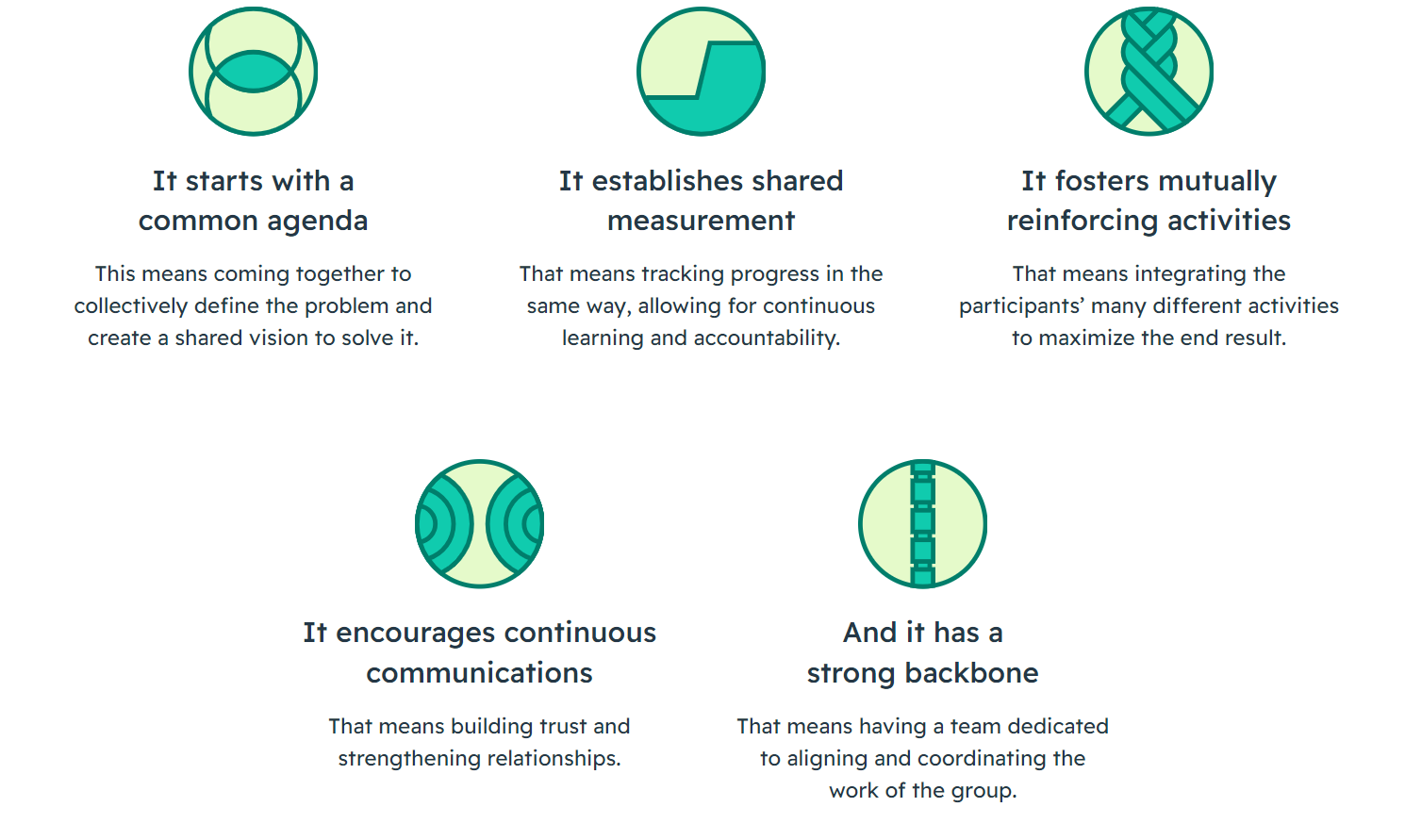

The six foundations for effective collaboration, as outlined in Collaborate CIC’s Guide to Collaboration (the guide covers what collaboration is, why and when it matters, a description for these six foundations for effective collaboration, and additional resources).

The Intersector Project’s stages of intersector collaboration and associated tools.

What questions should I be asking myself about how we collaborate with community members?
Who do we have at the table? Who do we not have at the table? What level of engagement/involvement in the coalition should various actors have, and how can we foster strong engagement/involvement?
What are the various power dynamics at play in our coalition (in terms of financial, political, social and other types of power)? Can we assess individual, team, and organizational power; make underlying power structures more explicit; and consciously identify ways to shift or share power in ways that make our work more community-driven and effective?
How are we working together, and is our approach efficient and effective? Is our strategic approach designed to add unique value to the community? What infrastructure have we built for information sharing and aligning work across organizations? Are we using our meeting time to accomplish what cannot be done via email or other communication?
How are we financing the work of our coalition and what implications does that have for what we can and cannot do, how resources are distributed, and how sustainable or not our work will be?
Are you feeling energized or overwhelmed by all this? Collaboration sounds (and is!) vital and valuable but it is also messy and difficult. It's more than worth the trouble though, so stay tuned for more strategies and ideas on how to do this well (or at least better!).
Sign up to receive future newsletters directly in your inbox at www.pophealthllc.com!

HOW to put community voices in the driver’s seat
Are you ever told to do something and find yourself wondering, “Yes, but HOW?”
With PoP Health’s 2024 newsletter series, we want to be sure to at least begin to answer that question. For each phase of our C.A.P.E. process that we introduce, we’ll have an initial post orienting us to the topic and a second post that answers the “Yes, but HOW?” question.
Are you ever told to do something and find yourself wondering, “Yes, but HOW?”
With PoP Health’s 2024 newsletter series, we want to be sure to at least begin to answer that question. For each phase of our C.A.P.E. process that we introduce, we’ll have an initial post orienting us to the topic and a second post that answers the “Yes, but HOW?” question.
So earlier this month, we introduced the first phase of our C.A.P.E. process, Community Collaboration, with a focus specifically on collaboration with community members (see issue here). Today, we’re here to share a set of FAQs that dive into tips, strategies, and resources about how to do this work and put community voices in the driver’s seat.
Can you share some tips for collaborating with community members?
Community voice isn’t enough if we merely hear it, but don’t listen to and act on it: Have a plan in place and hold yourself accountable to what you will DO based on what community members have to say.
Community members’ time is precious - treat it that way:
Don’t make community members repeat themselves - gather all the community input that’s already been collected in the community, including by other organizations and groups, and make sure you 1) learn from what’s already collected and 2) avoid duplicating what’s already collected.
Don’t make community members come to yet another meeting if it’s not necessary - there are likely dozens of community groups already gathering regularly that talk about the topics you’re exploring, so reach out to them, see if you can attend their meetings, listen, take notes, and let that information drive your planning process.
Don’t make community members share their time and expertise for free - compensate them. But remember that financial compensation is only one piece of the puzzle - to treat community members’ time as precious, you need to actually act on what you hear from them.
Build lasting, trusting, mutual relationships with community members:
Don’t be a fair weather friend - have a sustained presence in the community and continue to get to know and work together with community members, don’t reach out just when you need something from them.
Build collective capacity of the community - consider how to build on existing strengths and assets of the community and help community members build their own capacity and power - financial, political, and otherwise.
What are some specific strategies for collaborating with community members?
Focus the conversation through Focus Groups in a Box. Those best equipped to gather input from community members are the leaders and organizations that community members already trust and go to for support. If you want your work to be driven by the perspectives and experiences of community members, and the specific information you're seeking hasn’t already been collected in the community, consider awarding small research grants to community partners that are already gathering places for community members, so they can lead their own focus groups. Develop a standard focus group guide and reporting template to share with them, so they can lead conversations using the guide and report back what they hear using the reporting template.
In PoP Health’s work with the Allegheny County Infant Health Equity Coalition, our client Healthy Start Pittsburgh awarded these research grants, and PoP Health developed the standardized focus group guide and reporting template that was shared with grantees. The information we gathered through this process is directly reflected in the resulting action plan. This approach checked a bunch of boxes: we put the power in the hands of community members (they led the groups and were compensated for their time), we met community members where they already were, we heard from dozens of additional marginalized community members that we wouldn’t have reached otherwise, and we got meaningful feedback that could be incorporated directly into the plan. So many wins.
Share data and drive prioritization via Data Walks. We are huge advocates of taking a data-driven approach to community health improvement. But data does not live in a vacuum - it is only in interpreting data that we can inform efforts to transform health in our communities. And the question becomes - who is interpreting the data? It is vital that community members have an opportunity to review, understand, interpret, and utilize data about their own community. One way to do this is via data walks.
In PoP Health’s work with the Partnership for a Healthier Fairfax and the Fairfax County Health Department, we will be helping synthesize insights from a series of data walks the health department is conducting with community groups across the County. During the data walks, community data will be shared directly with community members in a visual, easily digestible form. Their reflections and thoughts on what's most in important will directly feed into the prioritization process used to identify priorities for the county's community health improvement plan.
Widen your reach with Street Stalls. Community led focus groups and data walks are great, but here's the thing - only a certain type of community member is already active in existing organizations or likely to come to an event like a data walk. There’s another type - actually many types - of community members that won’t. And sometimes - scratch that, most of the time - those are the folks we most need to hear from. Knocking door to door isn’t typically an option, but what we can do is gather community input on-site at community locations and events (think community centers, recreation centers, festivals, farmer’s markets).
PoP Health used this approach to gather input to inform the Children’s Behavioral Health Blueprint led by Healthy Minds Fairfax. With a simple tri-fold poster board (don’t underestimate the low-tech options!), a list of resources to vote on (using sticky dots) to indicate what they found most helpful, and an open-ended question to respond to (with post-it-notes and markers), we got helpful input from a wider range of community members and not just those that would self-select into completing a survey or participating in a focus group.
What are some resources to help me collaborate with community members?
Here are just a few examples of resources we here at PoP Health have personally found helpful in our work. This is by no means a comprehensive list - please email us to share other resources and tools you’ve found helpful in collaborating with community members!
Facilitating Power’s The Spectrum of Community Engagement to Ownership
The National Association of City and County Health Officials’ (NACCHO’s) Mobilizing for Action Through Planning and Partnership 2.0 resources, especially the Power Primer supplement
Human Impact Partners’ (HIP’s) Resources for Collaboration and Power Sharing and Activities to Deepen Your Power-Building Analysis
We hope these tips, strategies, and resources help begin to paint a picture of HOW to collaborate with community members and place more power in their hands.
It’s not a straightforward process, and if you’re anything like me, Reader, you’ll make plenty of mistakes along the way. But it’s absolutely vital and unquestionably worth it - we can’t transform health in our community without community members in the driver’s seat.
Sign up to receive future newsletters directly in your inbox at www.pophealthllc.com!

Putting community voices in the driver’s seat
In this post, we’ll dive into the first phase of our C.A.P.E. process: Community Collaboration.
This month, we’re going to focus specifically on collaboration with community members - today, we’ll get oriented to what we mean by that and in a couple weeks, we’ll walk through some specific strategies in this arena.
Without further ado, let’s get into it - FAQ style.
In this post, we’ll dive into the first phase of our C.A.P.E. process: Community Collaboration.
This month, we’re going to focus specifically on collaboration with community members - today, we’ll get oriented to what we mean by that and in a couple weeks, we’ll walk through some specific strategies in this arena.
Without further ado, let’s get into it - FAQ style.
What do you mean by collaborating with community members?
I like the idea of collaborating with community members instead of “engaging” them or “empowering” them.
Community engagement sometimes gets misinterpreted to include any superficial/half-hearted effort - what I call the “We talked to that one community member once and asked them leading questions so they could confirm what we already decided to do” approach. As my three year old has recently taken to saying (in response to just about everything) - no, thank you.
Community empowerment suggests we are giving power to community members. But we do not empower communities, they empower themselves.
Instead, we use the term community collaboration to capture a meaningful effort to listen deeply, put community voices in the driver’s seat, and actually take what we learn from listening to community members and work with them to act on it and make changes.
Listening is vital, but we can’t stop there.
What are some ways to think about how we collaborate with community members?
I love a good framework, and in the arena of collaborating with community members, “The Spectrum of Community Engagement to Ownership” (hat tip to Facilitating Power) is one of my go-tos. Community ownership moves beyond merely engaging the community to “foster[ing] democratic participation and equity through community-driven decision making”, helping bridge the gap between community and governance. We can’t get there in one fell swoop, but a step taken to move along this spectrum is a step in the right direction.

Source: Modified version of figure in The Spectrum of Community Engagement to Ownership by Facilitating Power
What questions should I be asking myself about how we collaborate with community members?
How long have we been a presence in the community? Have we built lasting, trusting, mutual relationships with community members? If not, how can we begin to take steps towards that?
Have we shown our respect for the voices and expertise of community members - by way of compensation, building from their existing strengths and assets, and ensuring they are driving the agenda and we are supporting them as opposed to vice versa?
What specific changes - to processes, decisions, investments, programs, policies, or systems - were made based on what community members had to say? What specific changes did we see in beliefs, behaviors, and health or other outcomes as a result?
What have we done to build collective capacity of the community, whether via training/capacity building activities, building political power, supporting mutual aid efforts, sharing financial ownership, or other means?
When you do this work well, you’ll feel the results. Have you had a community member tell you they feel heard and seen in your work? I can tell you from experience, it’s the best feeling. And more importantly, it’s the key to unlocking the kind of transformation we want to see in our communities.
Sign up to receive future newsletters directly in your inbox at www.pophealthllc.com!

Why we need to tell more stories
I’ve always loved stories - reading them, writing them, dancing them, hearing them.
One of the greatest joys of my work these days is partnering with community coalitions to tell their stories and the stories of their community members.
Narrative - that is, storytelling - holds immense power. Just in the last couple weeks, this has come up in three completely different projects PoP Health is working on:
I’ve always loved stories - reading them, writing them, dancing them, hearing them.
One of the greatest joys of my work these days is partnering with community coalitions to tell their stories and the stories of their community members.
Narrative - that is, storytelling - holds immense power. Just in the last couple weeks, this has come up in three completely different projects PoP Health is working on:
I was in Pittsburgh last week for the one-year celebration of implementation of the BIRTH Plan. A key part of PoP Health's role in this work is helping share the impact of implementing the plan in ways that resonate with community members. We’re lucky to be working with an amazing team over at Impact Aligned as well as our partners at Healthy Start Pittsburgh who are leading this work. All of us had many conversations where we grappled with how best to share our evaluation/learning data with partners and community, and ultimately realized we didn’t just want to share data - we wanted to tell a story. So, at the suggestion of our friends at Impact Aligned, we’re pivoting away from the idea of a traditional dashboard and instead considering storyboarding five key “impact stories” about the implementation of the BIRTH Plan and progress/outcomes to date that will be turned into videos - using data visualizations with an audio voiceover to tell a literal story. We are so excited about trying this approach and think it has the potential to be much more relatable, compelling, and easy-to-understand for community members.
Earlier this week, I was at a convening of a multi-partner school behavioral health collaborative in DC, and one of the parent advocates around the table brought up the two key perspectives she thought were missing from our table: a media person and a historian. This really struck me because these are not common roles brought up around public health focused coalition tables. But they should be - especially when we are talking about transforming communities through policy and systems change. This work cannot be divorced from the history of the community - we need to acknowledge, account for, and learn from history (history, if you will). We also need to share our stories - the stories we are informed by, the stories we are shaping, the stories of our impact and our failures too. So then it feels like of course we should have historians and media/communications professionals around our tables.
My colleague over at AES Consulting and I are working on a report related to cancer prevention communications and there are so many examples of the power of personal stories - one of them is about how colonoscopies increased 20% nationwide after Katie Couric received her first colonoscopy live on the Today show (i.e. “the Couric Effect”), a phenomenon I’m sure was also driven by her own moving personal story about her husband’s death from colon cancer. Similarly, when Magic Johnson went public with testing positive for HIV, this led to an uptick in testing in minority communities known as the “Magic Johnson effect”. Personal stories can often be more persuasive than data. I love the example of “deep canvassing” from door-to-door political campaigning. The strategy involves, first, a LOT of listening, followed by the canvasser trying to get the person at the door to reflect on a situation in their own life that might parallel the experience of someone the canvasser is hoping they can get the person to relate to - and it’s been found to be quite effective! (This is a strategy I learned about via the book Persuaders. Read my takeaways, which include a more detailed description of deep canvassing, here).
I’ve written about the power of narrative before (preview: I discuss in detail the TV show New Amsterdam and also share a fun exchange from when I met Atul Gawande at a book talk) and more recently the power of a storytelling sentence. I’m sure I’ll have more to share about the power of stories in the future too - it’s really a thread that runs through all aspects of my work and life.
Sign up to receive future newsletters directly in your inbox at www.pophealthllc.com!

The perils of trying to be everything to everyone
I was facilitating a coalition meeting recently and the conversation ended up going in circles for a bit - someone would propose an idea for a message or an activity and someone else would respond explaining why that wouldn’t resonate with or convince members of their community.
After a few rounds of this, someone interjected with a powerful idea - it’s one I’d heard before and you likely have too, but it bears repeating: Let’s say 20% of the community are strongly with us and 20% of the community will always be against us, no matter what we do. That leaves 60% - maybe we can focus on them instead of the 20% we’ll never be able to sway.
I was facilitating a coalition meeting recently and the conversation ended up going in circles for a bit - someone would propose an idea for a message or an activity and someone else would respond explaining why that wouldn’t resonate with or convince members of their community.
After a few rounds of this, someone interjected with a powerful idea - it’s one I’d heard before and you likely have too, but it bears repeating: Let’s say 20% of the community are strongly with us and 20% of the community will always be against us, no matter what we do. That leaves 60% - maybe we can focus on them instead of the 20% we’ll never be able to sway.
The percentages may change based on the issue, but the underlying concept does not: we can’t be everything to everyone. If we try to get to that 20% who will always be against us, we’ll either get stuck or put out a diluted message/program/policy in an attempt to appeal to everyone - but end up appealing to no one at all (including the 20% that was originally with us!).
Now, Reader, I know you might be thinking, “But it’s not just 20% at the far end of the spectrum!” Especially on politically charged topics, it might seem like almost everyone has a strong opinion, leaving hardly anyone “in the middle”. But what do we actually mean by people "in the middle”? One of my favorite thinkers/authors, Anand Giridharadas, has suggested that “moderates don’t exist”.
Moderation, he says, is about someone having a “less baked” or less certain viewpoint . It does not mean their view is exactly in the middle of the two extremes (I love Anand’s analogy for this – if I am undecided about whether I want a pizza or a burger, that doesn’t generally mean I want a pizzaburger.). Which is not to say that no one has a view exactly in the middle, some people do. But many others have “strong opinions, lightly held” – i.e., approached in the right ways, they can be persuaded.
So who is your 60%? Do they have “strong opinions, lightly held”? Can they be persuaded?
Of course, even within that 60%, not everyone is the same.
I studied health communications in grad school and taught an intro health communications course for several years - one of the key topics we covered was audience segmentation. This is something that commercial marketers (think cars and shoes and soda) do really well. They’re not trying to appeal to everyone with a particular message - their message is targeted and tailored to the particular values and perspectives of a narrow segment of the audience they’ve identified and spent a lot of time understanding. And if they want to appeal to a different segment of the audience, they’ll have a different message in a different channel.
Of course, the coalitions we work with and most public health organizations don’t have the resources that commercial marketers do.
But we can still think critically about who exactly our audience is and what segment of that audience we are trying to reach with a particular message or intervention.
As we often hear in the consulting world, there are “riches in the niches.” When you “niche down” and narrow your audience and services, you can speak to that very specific audience in a way that resonates deeply and makes people recognize that you understand and can address their specific needs.
It’s the same for any work or communication we undertake, whether as a coalition or an organization - we can’t be everything to everyone, but if we “niche down,” we might be surprised at just how effective we can be.
What is your favorite example of the power of “niching down” (or the perils of being everything to everyone)? Let me know!
Sign up to receive future newsletters directly in your inbox at www.pophealthllc.com!

A non-cringey survey that helps coalitions understand themselves
Today, I’m going to talk about surveys.
Does that make you cringe?
I understand if it does. Surveys get a bad rap.
We’re often trying to get participants in a program or members of a community to take a survey, and - often - we don’t provide enough context for them to buy into the value of the information they’re sharing or for them to believe any changes will result from their input. To be fair, and to make matters worse, oftentimes there aren’t changes made as a result of survey responses.
Today, I’m going to talk about surveys.
Does that make you cringe?
I understand if it does. Surveys get a bad rap.
We’re often trying to get participants in a program or members of a community to take a survey, and - often - we don’t provide enough context for them to buy into the value of the information they’re sharing or for them to believe any changes will result from their input. To be fair, and to make matters worse, oftentimes there aren’t changes made as a result of survey responses.
There is a time and place for participant/community surveys, we certainly use them in our work here at PoP Health, and we have some thoughts on how to make them less painful and more impactful - more to come on that in a later newsletter.
But today, I’m here to talk about a kind of survey that doesn’t have quite as many potential pitfalls. A non-cringey survey, if you will.
This is a survey that coalitions and collaboratives can use to reflect on themselves. For lack of a better name, we call them partnership surveys.
These surveys are solely for members of the coalition, and the results help coalition members understand who they are and what they bring to the table, where they already have a lot of energy and expertise to move things forward, and where they may have gaps that need to be filled.
As per the latest guidance from the National Association of City and County Health Officials (NACCHO)’s, by way of their Mobilizing Action through Planning and Partnerships 2.0 process, local health departments are encouraged to begin their community health improvement assessment process with exactly this kind of survey (they call it a Community Partners Assessment).
I mentioned this briefly in the last issue of Community Threads, but we used this kind of survey in advance of our kick-off meeting with the Perry County Health Coalition in Pennsylvania earlier this month. At the meeting, we shared the survey results - which painted a picture of:
Top action planning priorities;
What members hope to accomplish via participation in the coalition;
Current coalition composition, sectors and topics represented, populations touched by coalition member organizations, and suggestions around organizations, individuals, and communities to engage (either directly as coalition members or at other levels of engagement);
Alignment between member organization focus areas and focus areas identified in the 2022 health assessment the coalition completed;
Current and desired levels of engagement in the coalition;
Activities and tasks members are most interested in supporting;
Desired meeting format, frequency, and scheduling.
As you can imagine, by gathering this information ahead of the meeting and then sharing the synthesized responses and drawing out the key takeaways, we were able to facilitate a much more meaningful, nuanced discussion about where to go from here.
And since we were only surveying members of the coalition - who were already bought into the work of the coalition and wanted to actively use the results to inform their work - this survey rated pretty high on the non-cringey scale.
Have I convinced you that partnership surveys are non-cringey? Feel free to disagree with me (or share other examples of non-cringey surveys!) - drop me a line!
Sign up to receive future newsletters directly in your inbox at www.pophealthllc.com!

Leveraging the power of in-person gathering
I’ve been thinking a lot about the power of in-person gathering on the professional end as well. After a long summer vacation, this Fall has been a period of reconvening in person.
Last month, we had an in-person kick off for a DC School Behavioral Health Consortium that drove home the energy and sense of community that can come simply from sitting around the same table. I also loved the icebreaker the meeting conveners used to set the stage for our time together - they shared a collage of different images representing collaboration and asked each person, as we went around the room for introductions, to share which image resonated most with them and why. What a great way to orient the group to the reason we had come together and unearth some key distinctions and nuances in how each person at the table might approach this work. We’ve gotten used to “setting the stage” activities in virtual spaces, but they are just as valuable in in-person gatherings.
I’ve been thinking a lot about the power of in-person gathering on the professional end as well. After a long summer vacation, this Fall has been a period of reconvening in person.
Last month, we had an in-person kick off for a DC School Behavioral Health Consortium that drove home the energy and sense of community that can come simply from sitting around the same table. I also loved the icebreaker the meeting conveners used to set the stage for our time together - they shared a collage of different images representing collaboration and asked each person, as we went around the room for introductions, to share which image resonated most with them and why. What a great way to orient the group to the reason we had come together and unearth some key distinctions and nuances in how each person at the table might approach this work. We’ve gotten used to “setting the stage” activities in virtual spaces, but they are just as valuable in in-person gatherings.
Last week, we had our second annual set of Ignite presentations and data sensemaking sessions for our work (in partnership with the Center for Health and Healthcare in Schools at GW) as the Monitoring, Evaluation, and Learning partner for an antiracist, whole child development initiative in DC schools. Although this kind of sharing of our work and making sense of data visuals could, technically speaking, be done virtually, there is something about the power of being seated in a circle and lending our full attention to the discussion at hand that is hard to recreate on Zoom. There is also perhaps something even more powerful about the “sideline” conversations that occur between partner organizations during an in-person gathering, especially one that includes time to share meals together and catch up informally, as we did on both days of this convening. One of our partners emailed us after the event, “I wanted to thank you all for such an impactful convening this week. It was really inspiring to be around such a thoughtful group of educators/advocates and to be able to more deeply connect the dots across the entire project. I was even able to leave with immediate steps to further collaborate with [two of the other partner organizations on particular projects].” This is exactly what we hope can arise from bringing people together.
And finally, later this week, we are kicking off our partnership with the Perry County Health Coalition in Pennsylvania with an in-person convening of the coalition - the first time they’ll be gathering in person since 2019! So we’re trying to be thoughtful about how we make this brief time together as meaningful as possible. One thing we did is send around a survey and conduct a few interviews several weeks in advance of the meeting. We’ll be sharing our findings from the survey and interviews at the meeting as a launchpad for further discussion - this approach allows us to get the more obvious and consensus-y ideas shared quickly, leaving more of our precious in-person time to navigate the areas where there is complexity, uncertainty, or disagreement.
None of this is to say there is not unique power in virtual gathering - here at PoP Health, we love facilitating virtual convenings and have lots of tips and tools to make that time meaningful, engaging, and productive.
It’s just that this past month in particular, we’ve also been thinking a lot about the power of in-person gathering and how we can leverage that.
Reader, curious to hear your thoughts - in your experience, what’s the unique value-add of gathering in person? And how can we best leverage the power of those (sometimes rare) opportunities to be together in the same physical space? Drop me a note!
Sign up to receive future newsletters directly in your inbox at www.pophealthllc.com!