
The perils of trying to be everything to everyone
I was facilitating a coalition meeting recently and the conversation ended up going in circles for a bit - someone would propose an idea for a message or an activity and someone else would respond explaining why that wouldn’t resonate with or convince members of their community.
After a few rounds of this, someone interjected with a powerful idea - it’s one I’d heard before and you likely have too, but it bears repeating: Let’s say 20% of the community are strongly with us and 20% of the community will always be against us, no matter what we do. That leaves 60% - maybe we can focus on them instead of the 20% we’ll never be able to sway.
I was facilitating a coalition meeting recently and the conversation ended up going in circles for a bit - someone would propose an idea for a message or an activity and someone else would respond explaining why that wouldn’t resonate with or convince members of their community.
After a few rounds of this, someone interjected with a powerful idea - it’s one I’d heard before and you likely have too, but it bears repeating: Let’s say 20% of the community are strongly with us and 20% of the community will always be against us, no matter what we do. That leaves 60% - maybe we can focus on them instead of the 20% we’ll never be able to sway.
The percentages may change based on the issue, but the underlying concept does not: we can’t be everything to everyone. If we try to get to that 20% who will always be against us, we’ll either get stuck or put out a diluted message/program/policy in an attempt to appeal to everyone - but end up appealing to no one at all (including the 20% that was originally with us!).
Now, Reader, I know you might be thinking, “But it’s not just 20% at the far end of the spectrum!” Especially on politically charged topics, it might seem like almost everyone has a strong opinion, leaving hardly anyone “in the middle”. But what do we actually mean by people "in the middle”? One of my favorite thinkers/authors, Anand Giridharadas, has suggested that “moderates don’t exist”.
Moderation, he says, is about someone having a “less baked” or less certain viewpoint . It does not mean their view is exactly in the middle of the two extremes (I love Anand’s analogy for this – if I am undecided about whether I want a pizza or a burger, that doesn’t generally mean I want a pizzaburger.). Which is not to say that no one has a view exactly in the middle, some people do. But many others have “strong opinions, lightly held” – i.e., approached in the right ways, they can be persuaded.
So who is your 60%? Do they have “strong opinions, lightly held”? Can they be persuaded?
Of course, even within that 60%, not everyone is the same.
I studied health communications in grad school and taught an intro health communications course for several years - one of the key topics we covered was audience segmentation. This is something that commercial marketers (think cars and shoes and soda) do really well. They’re not trying to appeal to everyone with a particular message - their message is targeted and tailored to the particular values and perspectives of a narrow segment of the audience they’ve identified and spent a lot of time understanding. And if they want to appeal to a different segment of the audience, they’ll have a different message in a different channel.
Of course, the coalitions we work with and most public health organizations don’t have the resources that commercial marketers do.
But we can still think critically about who exactly our audience is and what segment of that audience we are trying to reach with a particular message or intervention.
As we often hear in the consulting world, there are “riches in the niches.” When you “niche down” and narrow your audience and services, you can speak to that very specific audience in a way that resonates deeply and makes people recognize that you understand and can address their specific needs.
It’s the same for any work or communication we undertake, whether as a coalition or an organization - we can’t be everything to everyone, but if we “niche down,” we might be surprised at just how effective we can be.
What is your favorite example of the power of “niching down” (or the perils of being everything to everyone)? Let me know!
Sign up to receive future newsletters directly in your inbox at www.pophealthllc.com!

A non-cringey survey that helps coalitions understand themselves
Today, I’m going to talk about surveys.
Does that make you cringe?
I understand if it does. Surveys get a bad rap.
We’re often trying to get participants in a program or members of a community to take a survey, and - often - we don’t provide enough context for them to buy into the value of the information they’re sharing or for them to believe any changes will result from their input. To be fair, and to make matters worse, oftentimes there aren’t changes made as a result of survey responses.
Today, I’m going to talk about surveys.
Does that make you cringe?
I understand if it does. Surveys get a bad rap.
We’re often trying to get participants in a program or members of a community to take a survey, and - often - we don’t provide enough context for them to buy into the value of the information they’re sharing or for them to believe any changes will result from their input. To be fair, and to make matters worse, oftentimes there aren’t changes made as a result of survey responses.
There is a time and place for participant/community surveys, we certainly use them in our work here at PoP Health, and we have some thoughts on how to make them less painful and more impactful - more to come on that in a later newsletter.
But today, I’m here to talk about a kind of survey that doesn’t have quite as many potential pitfalls. A non-cringey survey, if you will.
This is a survey that coalitions and collaboratives can use to reflect on themselves. For lack of a better name, we call them partnership surveys.
These surveys are solely for members of the coalition, and the results help coalition members understand who they are and what they bring to the table, where they already have a lot of energy and expertise to move things forward, and where they may have gaps that need to be filled.
As per the latest guidance from the National Association of City and County Health Officials (NACCHO)’s, by way of their Mobilizing Action through Planning and Partnerships 2.0 process, local health departments are encouraged to begin their community health improvement assessment process with exactly this kind of survey (they call it a Community Partners Assessment).
I mentioned this briefly in the last issue of Community Threads, but we used this kind of survey in advance of our kick-off meeting with the Perry County Health Coalition in Pennsylvania earlier this month. At the meeting, we shared the survey results - which painted a picture of:
Top action planning priorities;
What members hope to accomplish via participation in the coalition;
Current coalition composition, sectors and topics represented, populations touched by coalition member organizations, and suggestions around organizations, individuals, and communities to engage (either directly as coalition members or at other levels of engagement);
Alignment between member organization focus areas and focus areas identified in the 2022 health assessment the coalition completed;
Current and desired levels of engagement in the coalition;
Activities and tasks members are most interested in supporting;
Desired meeting format, frequency, and scheduling.
As you can imagine, by gathering this information ahead of the meeting and then sharing the synthesized responses and drawing out the key takeaways, we were able to facilitate a much more meaningful, nuanced discussion about where to go from here.
And since we were only surveying members of the coalition - who were already bought into the work of the coalition and wanted to actively use the results to inform their work - this survey rated pretty high on the non-cringey scale.
Have I convinced you that partnership surveys are non-cringey? Feel free to disagree with me (or share other examples of non-cringey surveys!) - drop me a line!
Sign up to receive future newsletters directly in your inbox at www.pophealthllc.com!

Leveraging the power of in-person gathering
I’ve been thinking a lot about the power of in-person gathering on the professional end as well. After a long summer vacation, this Fall has been a period of reconvening in person.
Last month, we had an in-person kick off for a DC School Behavioral Health Consortium that drove home the energy and sense of community that can come simply from sitting around the same table. I also loved the icebreaker the meeting conveners used to set the stage for our time together - they shared a collage of different images representing collaboration and asked each person, as we went around the room for introductions, to share which image resonated most with them and why. What a great way to orient the group to the reason we had come together and unearth some key distinctions and nuances in how each person at the table might approach this work. We’ve gotten used to “setting the stage” activities in virtual spaces, but they are just as valuable in in-person gatherings.
I’ve been thinking a lot about the power of in-person gathering on the professional end as well. After a long summer vacation, this Fall has been a period of reconvening in person.
Last month, we had an in-person kick off for a DC School Behavioral Health Consortium that drove home the energy and sense of community that can come simply from sitting around the same table. I also loved the icebreaker the meeting conveners used to set the stage for our time together - they shared a collage of different images representing collaboration and asked each person, as we went around the room for introductions, to share which image resonated most with them and why. What a great way to orient the group to the reason we had come together and unearth some key distinctions and nuances in how each person at the table might approach this work. We’ve gotten used to “setting the stage” activities in virtual spaces, but they are just as valuable in in-person gatherings.
Last week, we had our second annual set of Ignite presentations and data sensemaking sessions for our work (in partnership with the Center for Health and Healthcare in Schools at GW) as the Monitoring, Evaluation, and Learning partner for an antiracist, whole child development initiative in DC schools. Although this kind of sharing of our work and making sense of data visuals could, technically speaking, be done virtually, there is something about the power of being seated in a circle and lending our full attention to the discussion at hand that is hard to recreate on Zoom. There is also perhaps something even more powerful about the “sideline” conversations that occur between partner organizations during an in-person gathering, especially one that includes time to share meals together and catch up informally, as we did on both days of this convening. One of our partners emailed us after the event, “I wanted to thank you all for such an impactful convening this week. It was really inspiring to be around such a thoughtful group of educators/advocates and to be able to more deeply connect the dots across the entire project. I was even able to leave with immediate steps to further collaborate with [two of the other partner organizations on particular projects].” This is exactly what we hope can arise from bringing people together.
And finally, later this week, we are kicking off our partnership with the Perry County Health Coalition in Pennsylvania with an in-person convening of the coalition - the first time they’ll be gathering in person since 2019! So we’re trying to be thoughtful about how we make this brief time together as meaningful as possible. One thing we did is send around a survey and conduct a few interviews several weeks in advance of the meeting. We’ll be sharing our findings from the survey and interviews at the meeting as a launchpad for further discussion - this approach allows us to get the more obvious and consensus-y ideas shared quickly, leaving more of our precious in-person time to navigate the areas where there is complexity, uncertainty, or disagreement.
None of this is to say there is not unique power in virtual gathering - here at PoP Health, we love facilitating virtual convenings and have lots of tips and tools to make that time meaningful, engaging, and productive.
It’s just that this past month in particular, we’ve also been thinking a lot about the power of in-person gathering and how we can leverage that.
Reader, curious to hear your thoughts - in your experience, what’s the unique value-add of gathering in person? And how can we best leverage the power of those (sometimes rare) opportunities to be together in the same physical space? Drop me a note!
Sign up to receive future newsletters directly in your inbox at www.pophealthllc.com!

How to keep people engaged in community health improvement efforts
Have you ever struggled to keep people engaged in a community health improvement effort (or any effort, for that matter)?
I work with a lot of community coalitions and collaboratives, and most of them are volunteer-based, which makes this question of how to maintain engagement especially important. But even those that compensate their members for their involvement need to consider the question of how to keep people involved and inspired and motivated to participate and act in meaningful ways.
Have you ever struggled to keep people engaged in a community health improvement effort (or any effort, for that matter)?
I work with a lot of community coalitions and collaboratives, and most of them are volunteer-based, which makes this question of how to maintain engagement especially important. But even those that compensate their members for their involvement need to consider the question of how to keep people involved and inspired and motivated to participate and act in meaningful ways.
In my line of work, with public health focused coalitions, people are generally at the table because they care - they care about the health of the community and they want to help make it better. But there are so many services and supports to coordinate and so many partners to collaborate with; it’s hard to know where to start; and there is simply not enough time in the day, especially since most coalition members have their actual day jobs to do.
Whether you are recruiting members or trying to hold onto the ones you already have, what’s the secret to keeping folks engaged?
This week, I came across an interview with Arthur C. Brooks (a Harvard professor who studies, teaches, and writes about happiness) about “the secrets to happiness at work,” and I think it’s spot on and extremely relevant to this question of how we keep coalition members engaged in the work of the coalition.
Here’s what he says on this topic: “The two parts of work that really matter [for happiness at work] are not title, not money, not admiration, not power, [but] earned success and serving other people.”
Here’s how he describes these two concepts among workers: “They feel like they’re earning their success, which is to say that they’re creating value with their lives and with their work lives, that their accomplishments are moving the needle and they’re being recognized for those accomplishments. And number two, they feel like they’re serving people so that they’re needed.”
Do these two concepts resonate with you?
They did for me - when I think of the jobs I’ve been least satisfied with and the ones I’ve loved the most (including what I do now!), earned success and serving other people do seem like distinguishing factors.
In this interview, Brooks goes on to say, “The number one thing that you can do for recruitment, for retention, the ultimate rewards that go far beyond money are making sure that you have a system where people are earning their success through their merit and personal accomplishment. They know it, they see it, and so do their friends. And they actually feel like they’re serving other people and they can see the faces of the people for whom they’re creating value.”
And this, I think, is what community coalitions and collaboratives (and public health organizations and agencies more broadly) should be thinking about. How can we give people clear roles and responsibilities, where accomplishments they are striving for are clearly defined and celebrated once achieved? How can we make meaningful connections between the members/employees of our coalitions/organizations and the community members we serve, so the value we’re creating can be truly seen and felt?
These are the questions I leave you with today- I would love to hear your thoughts!
Sign up to receive future newsletters directly in your inbox at www.pophealthllc.com!

The power of a storytelling sentence
When it comes to community health improvement, we often find ourselves in situations where we need to tell a compelling story. To name just a few:
We need to convey the impact and value of a particular health issue to a policymaker so they are motivated to write or pass legislation that would help address it.
We need to share the impact a policy or program is having with our funders and communities so they are inspired to help sustain it.
When it comes to community health improvement, we often find ourselves in situations where we need to tell a compelling story. To name just a few:
We need to convey the impact and value of a particular health issue to a policymaker so they are motivated to write or pass legislation that would help address it.
We need to share the impact a policy or program is having with our funders and communities so they are inspired to help sustain it.
We need to share data from a community survey so community partners understand the top health-related needs community members are facing so that their organizations can take action to meet those needs.
PoP Health is knee-deep in each of these types of storytelling at the moment. And we’re often using data - both quantitative and qualitative - to tell these stories. We typically have a LOT of data - thankfully we work with amazing analysts who can synthesize this data into powerful, digestible visualizations.
But visualizations only tell a story if you can interpret them effectively.
One of the things I’ve come to appreciate deeply is the immense power of a storytelling sentence.
Take a data visualization and ask yourself, what do I want the person seeing this to takeaway from this?
And then write that down as simply and briefly as you can.
That’s your storytelling sentence.
Maybe it’s the title of your graph or visual, maybe it’s a summary sentence you place to the side or below.
It sounds so simple but it’s amazing how often we skip this step. This happens a lot especially with data dashboards.
You might build a high-quality, dynamic data dashboard. But will a community member or community partner seeing that dashboard know at first glance what they should be taking away from it? If you add those storytelling sentences, they will!
So this is a call to tell your story. Don’t leave it to chance or someone else’s interpretation. Don't assume the numbers speak for themselves. It's your story - so, tell it!
Sign up to receive future newsletters directly in your inbox at www.pophealthllc.com!
The shifts that come from listening
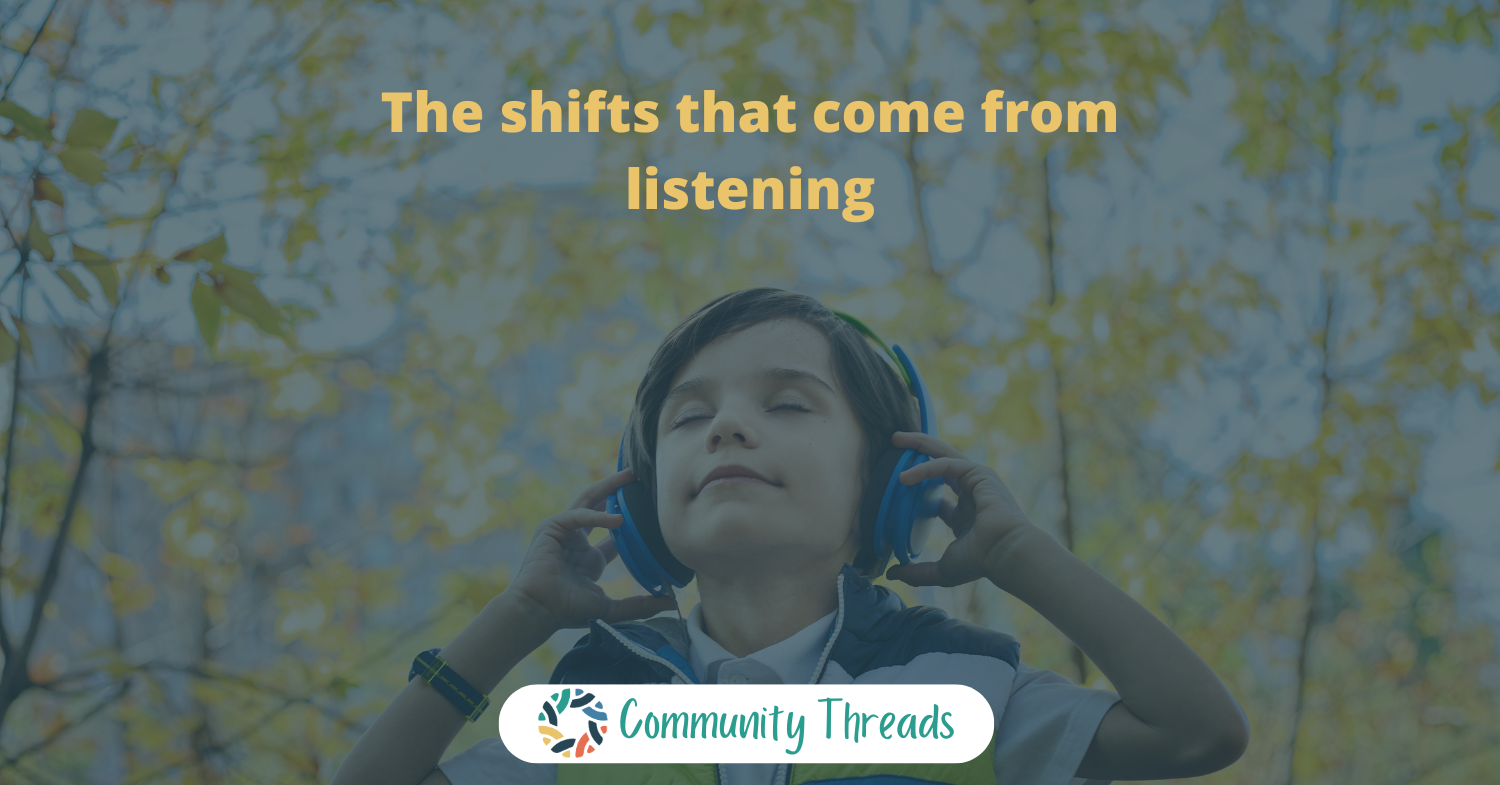
I've talked about the difference between hearing and listening to community before.
And even though it's something I believe in deeply, I'm still surprised at the shifts that happen when we truly do that.
A couple weeks ago, for work I'm doing in DC around systems-level shifts to school mental health, we brought together youth to generate ideas around how to improve youth engagement in the school context.
Here are some of the ideas that came up repeatedly:
I've talked about the difference between hearing and listening to community before.
And even though it's something I believe in deeply, I'm still surprised at the shifts that happen when we truly do that.
A couple weeks ago, for work I'm doing in DC around systems-level shifts to school mental health, we brought together youth to generate ideas around how to improve youth engagement in the school context.
Here are some of the ideas that came up repeatedly:
"Having an area where we can take a break/chill"
"I WANT A MENTAL HEALTH DAY"
"Having more relatable/trusted adults"; "Respect is a two way street"
If we asked adults how we can improve youth engagement in the school context, what answers would we have gotten? I'm willing to bet this list would have been completely different.
So far, we've just heard these young people. How can we listen to them? By figuring out how to make more of these things happen! One thing that struck me about these ideas that bubbled to the top are that in theory, they shouldn't be that hard to make happen - but it does require adults setting aside their own perspectives and egos and prioritizing what young people most want.
One student shared how one of their teachers opens their room to students during lunch time, and how deeply they appreciate that space to chill - and only when I heard that did I remember some of my favorite memories from high school were in Mrs. Fort's English lit classroom, where a handful of us would go at least a few times a week to have our lunch.
Several students talked about specific teachers or other adults in the building that made them feel respected. What did that boil down to? The adult cared what the students had to say. They didn't talk down to the students. They made things fun. They listened. The conversation made me think of my favorite teachers through the years - they checked all those boxes too.
We were all young people once, but we quickly forget the day-to-day of that experience and how we felt about things.
If we can truly listen to and act upon what we hear from young people - or whoever your community members are - we might shift not only our solutions but even how we define problems.
But listening isn't always easy.
I've been thinking a lot about how we practice listening. We recently had a friend visit who loves birdwatching and taught our six year old more about birds in a weekend than we could have taught her, well...ever. But my favorite part of the whole experience was the emphasis on being still and listening - it's amazing what you hear when you do that.
Sign up to receive future newsletters directly in your inbox at www.pophealthllc.com!

15% and 15x solutions
Do you ever feel powerless to tackle the big problems your community faces?
I often feel that way, and I think many of us do.
On the other hand, do you ever feel like our solutions aren’t enough - not big enough, not disruptive enough, not transformational enough?
Do you ever feel powerless to tackle the big problems your community faces?
I often feel that way, and I think many of us do.
On the other hand, do you ever feel like our solutions aren’t enough - not big enough, not disruptive enough, not transformational enough?
Especially when trying to improve community health and well-being, it can often feel constraining to work within existing systems instead of thinking about how we dismantle and rebuild the systems themselves.
My colleague and I are facilitating a national convening next week, and the group will be brainstorming and prioritizing public health solutions to address dementia. We’ve tried to ensure each session incorporates a slightly different approach to brainstorming - to keep things interesting and make sure new ideas keep flowing.
In one of the sessions, I wanted to address both these struggles - sometimes we get stuck brainstorming because it feels like the only way to change things is big, huge, systems-level transformation and we feel powerless to make that happen. On the other hand, sometimes we get stuck brainstorming because all we can come up with are ideas that would make small changes on the margins, but nothing that feels big enough to create real change.
The reality is, we need to brainstorm and move forward on both fronts.
15% Solutions, a type of Liberating Structure (i.e., alternatives to presentations, managed discussion, and other conventional structures that typically guide the way groups work together), invites those brainstorming to consider: “What is your 15 percent? Where do you have discretion and freedom to act? What can you do without more resources or authority?”
I love the way the Liberating Structures website describes what is made possible through this approach: “You can reveal the actions, however small, that everyone can do immediately. At a minimum, these will create momentum, and that may make a BIG difference. 15% Solutions show that there is no reason to wait around, feel powerless, or fearful. They help people pick it up a level. They get individuals and the group to focus on what is within their discretion instead of what they cannot change.”
I have found it works well to pair this 15% solution question with another question borrowed from Liberating Structures that’s about getting 10 times (or we’ll make it 15 times to make it parallel with 15%!) bolder - “If you were [fifteen] times bolder, what big idea would you recommend? What first step would you take to get started?”
What’s made possible through this approach is the flip side of what’s made possible via 15% solutions - there are bold, transformational things that would move us towards transforming community health (or whatever you’re trying to transform!) and while they may not be within our control, we can identify some initial steps to take towards them.
I think pairing these questions together is powerful. You can have participants brainstorm 15% solutions on one color of post-it note in the first part of a session and 15x solutions on another color in the second part of the session.
We can both be empowered by the things we can do fully within our circle of influence and inspired by the things that are more aspirational and transformational - which may take a lot longer (even generations) to accomplish but can still be pursued by starting with a first step.
Let me know if you have tried this kind of brainstorming before or have other approaches that have worked well!
Sign up to receive future newsletters directly in your inbox at www.pophealthllc.com!

The value of ONE right door
Have you heard the phrase "no wrong door" before?
A Google search didn't bring up a standard or formal definition, but the description I found that most aligns with my understanding of the concept is this:
"The vision for No Wrong Door is that every door in the region’s healthcare and human services system should be the right door with a range of services being accessible to everyone from multiple points of entry."
This is a lovely and logical idea in theory.
But I have come to question how well it works in practice.
Have you heard the phrase "no wrong door" before?
A Google search didn't bring up a standard or formal definition, but the description I found that most aligns with my understanding of the concept is this:
"The vision for No Wrong Door is that every door in the region’s healthcare and human services system should be the right door with a range of services being accessible to everyone from multiple points of entry."
This is a lovely and logical idea in theory.
But I have come to question how well it works in practice.
I work closely with a school mental health collaborative in DC and at our meeting a couple weeks ago, one of the members shared with us results from an evaluation of DC's school behavioral health expansion. There were bright spots and progress to celebrate, but one thing that stood out to me in terms of challenges that remain was that about half of students reported still not knowing where to go for help in the school. We have heard our partners who lead parent advocacy in DC lament about this too - even parents who are deeply engaged in advocating for their children don’t know where to turn or what resources are available at their own schools. This is clearly not due to a lack of involvement on their part, so why is this happening?
Let me share a counterintuitive guess with you - I don’t think the problem is that there is nowhere for them to turn. I think the problem is there are too many places for them to turn.
This is a theme we heard repeatedly in community input gathering to inform the Fairfax Children's Behavioral Health Blueprint.
Imagine that you’re Kira - a mom with two elementary school aged kids, one of whom is in need of mental health supports. You reach out to various folks within the school and community for suggestions, and each person hands you a list of resources available for kids with mental health needs. There are so many resources that you’re overwhelmed about where to start and how to choose one. But you decide to just pick one at random and call them. Turns out they are no longer in business. You try another number. They don’t have any spots available. You move to the next number on the list. They do have availability starting next month but your income is too high for you to be eligible. The next place doesn’t have supports for the kind of mental health issue your child is struggling with. And on, and on, and on.
While the idea of "no wrong door" is great in theory, in practice, it often involves someone behind every door being equipped with a list of other places and people to point someone to. This would be fine if the lists were kept updated, limited to services that were currently available, categorized by eligibility, and tailored to specific needs - but they are rarely any of those things, much less all four.
What people most need is not a laundry list of generic resources that may or may not be available to or appropriate for them. What they need is a way to navigate to the right solution for them - whether that is by way of a person (like a navigator or case manager), an interactive database (imagine being Kira and having a website where you could type in your child’s age, their mental health needs, your family income, your insurance, etc. and receive a list of organizations that currently offer services that meet your specific needs and eligibility), or some other solution (Have an example or ideas? Email me!)
What people often need is one right door - someone or something to help them navigate through all that's available to find the right fit for them.
This is true for mental health support, for childcare, for any number of other needs people are seeking services for.
As anyone who’s ever been handed a laundry list of resources can vouch for, sometimes too many doors can actually leave us feeling lost. If we can shift more systems to create one right door, maybe we can connect far more people with the services and supports they need - not just in theory, but in reality.
Sign up to receive future newsletters directly in your inbox at www.pophealthllc.com!
Just do it. Then iterate.
Whatever idea you’ve been mulling over, considering, planning for…just do it.
Now, I know it’s not that simple (in most cases).
Maybe you can’t "just do it” because you don’t have the authority. Or because you need to assess the potential consequences. Or any one of a dozen other perfectly valid reasons.
Whatever idea you’ve been mulling over, considering, planning for…just do it.
Now, I know it’s not that simple (in most cases).
Maybe you can’t "just do it” because you don’t have the authority. Or because you need to assess the potential consequences. Or any one of a dozen other perfectly valid reasons.
But there are also many cases when we could "just do it" and we let something stop us. Sometimes it's perfectionism. Sometimes it's fear.
Whatever the reason, it's getting in the way of the magic of just doing it, and then iterating.
As an engineering major in college, I was trained to "fail fast". Now, I don't love thinking about it as failure per se, but it's true that the first attempt is rarely going to be a home run. So just do it. Get it out of the way. Learn as much as you can from the experience and then revise, making it better each time.
Last year, as part of a volunteer team under the umbrella of the Partnership for a Healthier Fairfax, I helped organize the very first Healthy Together Fairfax, a fun, free, interactive community event focused on healthy and active living, with hands-on activities, fitness classes, access to community services and resources, etc.
The event was set to take place at an amazing county park that has a beautiful trail walk, amphitheater, treehouse, playground, carousel, and tons of green space. My co-volunteer who is a whiz at these things put together a thoughtful, color-coded layout for how all our exhibitors would be spread out throughout the park, organized into groups based on the health topics they addressed.
Then Hurricane Ian brought a storm our way and we had to move everything indoors. We were locked out of the iPads we planned to use for exit surveys. Someone whose proposal to participate we had not accepted showed up to exhibit anyway. The list goes on.
But you know what? Despite it all, we had a WONDERFUL event - exhibitors and community members were engaged and learning from one another, we had a number of local agency heads and policymakers come read children’s story books focused on social and emotional health, we had a steady stream of fitness classes and other interactive, community health-focused activities, and everyone - organizers, exhibitors, and attendees alike - expressed excitement about doing it again next year.
But that's not all. We recently held a community meeting to plan for this year's event and we had so many people show up with so many great ideas. When we tried to do something similar last year, we had almost no one show up.
What changed? We've done it once! That means…
We got a broader coalition on board through partners that participated in the event last year.
People saw it in action and understood our vision, so they got more excited about it themselves and shared it with others.
We got some systems and templates built out, meaning we could start our planning earlier and stronger this year, all while putting in fewer hours.
We learned from last year - this year, we have a rain date set that we’re publicizing from the start, we’ve moved our timeline up so we’ll have exhibitors identified early enough to be actively included in event promotion efforts, we’ll set the exit survey ipads up differently, and so on and so forth.
So my point is - if you can, just do it. Don’t worry about getting it all right or what might go wrong - you won't get everything right, things will go wrong, AND it will still be wonderful (or at the very least, you’ll get your “first pancake” out of the way - as a firstborn child, I feel like I get a pass to share this meme). Most importantly, you’ll learn from it, and be able to do something even better in the next iteration.
What have you been thinking about or planning for that you're feeling ready to just do? Or, if something's stopping you, what is it? Let me know!
Sign up to receive future newsletters directly in your inbox at www.pophealthllc.com!

A fish, an elephant, and an iceberg: Orienting community towards root causes and systems
When a community is trying to address a public health problem, the immediate causes are often the most apparent.
Too many youth aren't physically active. Why? They don't understand the value of physical activity or the consequences of not being active. What should we do? An education and mass communication campaign to help them understand this value and these consequences, so that they are motivated to be more active.
When a community is trying to address a public health problem, the immediate causes are often the most apparent.
Too many youth aren't physically active. Why? They don't understand the value of physical activity or the consequences of not being active. What should we do? An education and mass communication campaign to help them understand this value and these consequences, so that they are motivated to be more active.
Not only are immediate causes often the most apparent, the solutions required to address them are often (relatively) non-controversial and don't require the upheaval of established systems.
But to truly transform health in communities, we need to move beyond the immediate. We need to 1) drill down to root causes and 2) fly up for a systems wide view.
On the first point -
WHY are too many youth not physically active? Do they have safe spaces to run and play in their neighborhood, and do their schedules allow them to do so? Are the costs of joining recreational sports leagues prohibitive? Are the apps on their phones designed to be addictive, so they have less time for everything else?
To get community members thinking about root causes, one exercise I have found quite helpful is a fishbone diagram (where you start with the problem, which is the "head" of the fish, and then brainstorm multiple causes, as well as causes of causes). This diagramming is often paired with the "5 whys" facilitation strategy (where you keep asking "why" five times to drill down to deeper root causes). The idea here is that this process can help identify countermeasures (things that prevent root causes) instead of merely solutions (things that might just put a bandaid on the problem by treating a symptom instead of a root cause).

On the second point -
HOW might systems be transformed to encourage more physical activity among youth?
First, we need to be able to take a step back and see the system as a whole. I find the elephant analogy an incredibly helpful way to remind ourselves and our communities to do this. It’s an ancient parable you may have heard before about blind/blindfolded individuals encountering an elephant for the first time. Each person feels only one part of the elephant and comes to a conclusion about what they are encountering based on that. It leads to a lot of misconceptions and no single person who has the full and accurate picture.

To take community thinking a step further, from recognizing there is a broader system to understanding how we can improve that system, I love using the iceberg model of systems thinking. It's a great way to reminder ourselves that what we can see of a problem is usually only the tip of the iceberg. "We know that an iceberg has only 10 percent of its total mass above the water while 90 percent is underwater. But that 90 percent is what the ocean currents act on, and what creates the iceberg’s behavior at its tip." Most public health issues are like this as well! I especially appreciate the way this model helps community members walk through the process of identifying trends, underlying structures, and ultimately mental models.

I've often had clients point to a fairly surface-level approach or solution and say, "This is what our community said they want to see." This may be true, and I'm 100% on board with community-driven approaches. However, we also need to ask ourselves if we've walked ourselves and our communities through the kind of tools above to make sure that the solutions we're brainstorming are oriented towards root causes and systems.
Have you had success with setting the stage to approach problems in a way that is focused on root causes or systems? Or have you tried using any of the tools mentioned above? Please share your experience with me!
Sign up to receive future newsletters directly in your inbox at www.pophealthllc.com!