
HOW to collaborate across your collaborative: What we can learn from Underpants Gnomes and other tips, strategies, and resources
Here at PoP Health, as we spring forward, we are also springing into part two of the first phase of our C.A.P.E. process: Community Collaboration - focused specifically on collaborating across your collaborative.
What do you mean by collaborating across our collaborative?
As I read in a recent post from Collaborate CIC, a UK-based social consultancy, “Calling something collaborative doesn’t necessarily make it so.”
Are you tried of hearing the word "collaborate", Reader?
I know the word can sometimes seem…empty. Something everyone pays lip service to but that we don’t often explore HOW to do well.
That’s our goal here at PoP Health - not just to talk about collaboration a lot (which, admittedly, we are guilty of!) but to also dive deeply into HOW we can do this well.
Earlier this month, we introduced the “collaborating with your collaborative” aspect of our C.A.P.E. process (see issue here) and today, we’re going to dive into the “Yes, but HOW?” question with some tips, strategies, and resources.
Can you share some tips for collaborating across your collaborative?
Move beyond information sharing. Far too often, we see collaborative meetings that are nothing more than surface-level information sharing about what each member organization is doing. This could just as easily - if not more easily - be done offline. When you convene your collaborative, make it about something that couldn’t be done offline or asynchronously - a space for creativity and generating new ideas, a space for collective sensemaking and achieving new understanding, a space for unearthing complexities and conflicts.
Make sure your members each have a clear role. Collaboration does not mean everyone does everything. Both recruitment and retention are difficult if an individual member of your collaborative doesn’t see a clear role for themselves. People’s time is limited and valuable, and collaborative membership is often on a volunteer basis, something taken on in addition to a person’s day-to-day job responsibilities. If they feel that their absence from the collaborative isn’t going to have an impact, they will not care to join or stay. When you ask someone to join the collaborative, make sure you describe their exact role and responsibilities, and why they are uniquely suited for it. And make sure one or more of those roles includes leadership of the collaborative!
Establish a system where the collaborative - collectively and also each individual member - earns their success and sees and feels the value they create. This is a lesson from happiness researcher Arthur C. Brooks. He says, “The number one thing that you can do for recruitment, for retention, the ultimate rewards that go far beyond money are making sure that you have a system where people are earning their success through their merit and personal accomplishment. They know it, they see it, and so do their friends. And they actually feel like they’re serving other people and they can see the faces of the people for whom they’re creating value.” Make sure the accomplishments the collaborative is striving for - and that individual members are pursuing - are 1) clearly defined, 2) celebrated once achieved, and 3) connected directly to the value that’s created in the community, ideally by fostering meaningful connections between collaborative members and community members so the value that’s created in the community can be truly seen and felt by collaborative members.
Unearth underlying power dynamics. As Collaborate CIC puts it, “For collaboration to be effective, we need to be able to talk about where power lies, how it plays out, and how power dynamics (and behaviors, governance, and so on) need to change to make space for everyone to genuinely contribute in ways that make sense for them.” There are various types of power (financial, political, social and other types of power) and assessing them - at individual and organizational levels - and making them explicit can help set your collaborative on a path towards consciously identifying ways to shift or share power in ways that make the work more community-driven and effective.
What are some specific strategies for collaborating across your collaborative?
Conduct a partnership survey. I know, I know, surveys get a bad rap, and justifiably so. But this is an idea for a non-cringey survey, a survey your collaborative uses to reflect on themselves. These surveys are solely for members of the collaborative, and the results help collaborative members understand who they are and what they bring to the table, where they already have a lot of energy and expertise to move things forward, and where they may have gaps that need to be filled.
We used this kind of survey in advance of our kick-off meeting with the Perry County Health Coalition in Pennsylvania. We asked about top action planning priorities; what members hope to accomplish via participation in the coalition; current coalition composition, sectors and topics represented, populations touched by coalition member organizations, and suggestions around who else to engage; alignment between member organization focus areas and focus areas identified in the most recent health assessment the coalition completed; current and desired levels of engagement in the coalition; activities and tasks members are most interested in supporting; and desired meeting format, frequency, and scheduling.
By gathering this information ahead of the meeting and then sharing the synthesized responses and drawing out the key takeaways, we were able to facilitate a much more meaningful, nuanced discussion about where to go from here.
Collectively develop a joint Theory of Change. Have you heard of the Underpants Gnomes, Reader? I feel in love with this clip when a friend introduced it to me:
In this episode of South Park, the boys encounter a group of gnomes who’ve been very busy stealing underpants as part of a big plan. Phase 1 is collect underpants. Phase 3 is profit. But in between? A giant question mark.
In the “collect underpants” context, this seems a little wild. But you’d be surprised how very often this happens in our work with public health focused coalitions and collaboratives. We have an end goal in mind and a set of activities we’re going to launch, but we haven’t actually mapped out exactly why and how we believe these activities are going to get us to that end goal.
Enter a theory of change. We are especially strong advocates for bringing your collaborative together and jointly developing a theory of change that everyone contributes to and - by the end, after rounds of revision - agrees with and endorses.
This is something we did to launch our work co-leading evaluation and learning for a whole-child development initiative in DC public schools. We got everyone together in person and had them react to an initial theory of change our team developed based on our understanding of the work. We tore it apart during this meeting, revised it, conducted follow up interviews with each partner to get their reactions to the revised version, revised it further, and finally landed upon a version that everyone “stamped” with their approval.
This was over two years ago and we STILL root all our work and evaluation in that theory of change. It has been an incredibly helpful grounding and guiding force.
Have collaborative partners lead Ignite Talks. In that same DC project, once we were a little further along into implementation, partner organizations expressed a desire to know more about the activities other partners were leading. Because as useful as our Theory of Change has proven, words on paper are no substitute for a true understanding of how the work looks, sounds, and feels on the ground where it’s happening.
One of my colleagues on the project suggested using the Ignite Talks format - “20 slides, 15 seconds a slide, 5 minutes on stage, just you and the audience”. The emphasis in this format is on highly visual slides with interesting imagery. It’s similar to the PechaKucha format, which originated in Japan, and involves 20 slides, each for 20 seconds.
We used these talks to open an in-person convening and it was lively, engaging, interesting, and everyone learned a lot about the different elements of this joint effort we were engaging in.
By emphasizing visuals, we got to see what the work looked like in action. By forcing everyone into a new presentation format, we escaped the boilerplate slides and explanations we otherwise would have gotten. Perhaps most surprisingly, by providing a tiny bit of extra structure (“20 slides, 15 seconds each” - instead of just saying “no more than 5 minutes, please”), we actually had everyone stay within the time limit - every single person. (Who else has tried the “no more than X minutes, please” route before, only to find that no one listened to you? Turns out, a little extra structure is the answer!)
What are some resources to help me collaborate with community members?
Here are just a few examples of resources we here at PoP Health have found helpful - some related to the specific tips and strategies noted above, and others more general. This is by no means a comprehensive list - please email us to share other resources and tools you’ve found helpful in collaborating across your collaborative!
Collaborate CIC’s Common Misconceptions About Collaboration
The National Association of City and County Health Officials’ (NACCHO’s) Mobilizing for Action Through Planning and Partnership 2.0 resources, especially the Community Partner Assessment survey tool
Collective Impact Forum’s Resource Library
The various other collaboration frameworks highlighted in the previous issue of this newsletter
These tips, strategies, and resources begin to paint a picture of HOW to collaborate across your collaborative. It’s a messy, slow, challenging process - but it can also be a creative, illuminating, and rewarding one. We hope what we’ve shared helps you navigate the challenges and reap the rewards!
Sign up to receive future newsletters directly in your inbox at www.pophealthllc.com!

Collaborating across your collaborative: helpful frameworks and questions to ask yourself
Here at PoP Health, as we spring forward, we are also springing into part two of the first phase of our C.A.P.E. process: Community Collaboration - focused specifically on collaborating across your collaborative.
What do you mean by collaborating across our collaborative?
Here at PoP Health, as we spring forward, we are also springing into part two of the first phase of our C.A.P.E. process: Community Collaboration - focused specifically on collaborating across your collaborative.
What do you mean by collaborating across our collaborative?
As I read in a recent post from Collaborate CIC, a UK-based social consultancy, “Calling something collaborative doesn’t necessarily make it so.”
Having multi-sector partners around the same table doesn’t necessarily equal collaboration.
Convening partners on a regular basis doesn’t necessarily equal collaboration.
Having a shared vision and mission doesn’t necessarily equal collaboration.
True collaboration requires moving beyond sharing information and learning from one another - to taking intentional, strategic, collective ACTION.
We’ll get more into specific strategies for collaboration and action planning in future newsletters, but for now, let’s get oriented to the idea of collaborating across a collaborative.
What are some ways to think about how we collaborate across our collaborative?
There are so many frameworks for collaboration and collective action, and I don’t think any one of them are “THE” answer. I do, however, think that some of them are particularly useful in thinking through how your collaborative currently collaborates and whether you’d like to move further along the collaborative spectrum and how. These include:
The collaboration spectrum by Tamarack Institute (see p8 of their report for a table that outlines not only the definitions below, but also the collaborative types, convening leadership, authority, shared ownership, key governance documents, and outcomes for each level of collaboration).

Forms and features of collaboration, by Collaborate CIC and Dartington Service Design Lab and commissioned by The Health Foundation (check out their report for definitions and examples of each of these forms of collaboration as well as key features, including make-up of the collaboration, governance, communications, evaluation and learning, and resources).

The community system solutions framework, published in the Stanford Social Innovation Review (the article includes key features of each of the types outlined in the diagram below, along with examples).

The five conditions of collective impact and five equity strategies by the The Collective Impact Forum (their getting started page includes a robust set of associated tools and resources).
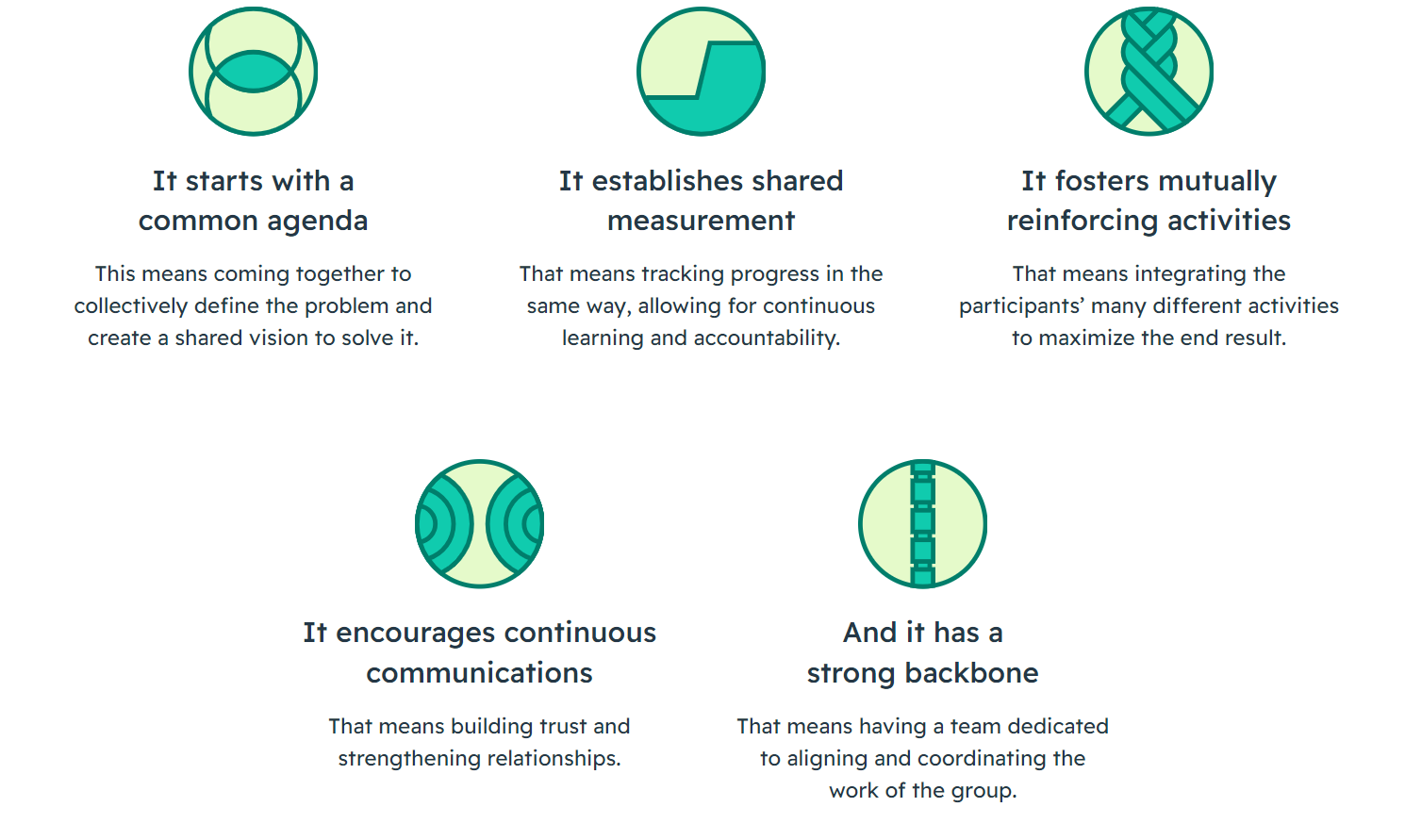

The six foundations for effective collaboration, as outlined in Collaborate CIC’s Guide to Collaboration (the guide covers what collaboration is, why and when it matters, a description for these six foundations for effective collaboration, and additional resources).

The Intersector Project’s stages of intersector collaboration and associated tools.

What questions should I be asking myself about how we collaborate with community members?
Who do we have at the table? Who do we not have at the table? What level of engagement/involvement in the coalition should various actors have, and how can we foster strong engagement/involvement?
What are the various power dynamics at play in our coalition (in terms of financial, political, social and other types of power)? Can we assess individual, team, and organizational power; make underlying power structures more explicit; and consciously identify ways to shift or share power in ways that make our work more community-driven and effective?
How are we working together, and is our approach efficient and effective? Is our strategic approach designed to add unique value to the community? What infrastructure have we built for information sharing and aligning work across organizations? Are we using our meeting time to accomplish what cannot be done via email or other communication?
How are we financing the work of our coalition and what implications does that have for what we can and cannot do, how resources are distributed, and how sustainable or not our work will be?
Are you feeling energized or overwhelmed by all this? Collaboration sounds (and is!) vital and valuable but it is also messy and difficult. It's more than worth the trouble though, so stay tuned for more strategies and ideas on how to do this well (or at least better!).
Sign up to receive future newsletters directly in your inbox at www.pophealthllc.com!

HOW to put community voices in the driver’s seat
Are you ever told to do something and find yourself wondering, “Yes, but HOW?”
With PoP Health’s 2024 newsletter series, we want to be sure to at least begin to answer that question. For each phase of our C.A.P.E. process that we introduce, we’ll have an initial post orienting us to the topic and a second post that answers the “Yes, but HOW?” question.
Are you ever told to do something and find yourself wondering, “Yes, but HOW?”
With PoP Health’s 2024 newsletter series, we want to be sure to at least begin to answer that question. For each phase of our C.A.P.E. process that we introduce, we’ll have an initial post orienting us to the topic and a second post that answers the “Yes, but HOW?” question.
So earlier this month, we introduced the first phase of our C.A.P.E. process, Community Collaboration, with a focus specifically on collaboration with community members (see issue here). Today, we’re here to share a set of FAQs that dive into tips, strategies, and resources about how to do this work and put community voices in the driver’s seat.
Can you share some tips for collaborating with community members?
Community voice isn’t enough if we merely hear it, but don’t listen to and act on it: Have a plan in place and hold yourself accountable to what you will DO based on what community members have to say.
Community members’ time is precious - treat it that way:
Don’t make community members repeat themselves - gather all the community input that’s already been collected in the community, including by other organizations and groups, and make sure you 1) learn from what’s already collected and 2) avoid duplicating what’s already collected.
Don’t make community members come to yet another meeting if it’s not necessary - there are likely dozens of community groups already gathering regularly that talk about the topics you’re exploring, so reach out to them, see if you can attend their meetings, listen, take notes, and let that information drive your planning process.
Don’t make community members share their time and expertise for free - compensate them. But remember that financial compensation is only one piece of the puzzle - to treat community members’ time as precious, you need to actually act on what you hear from them.
Build lasting, trusting, mutual relationships with community members:
Don’t be a fair weather friend - have a sustained presence in the community and continue to get to know and work together with community members, don’t reach out just when you need something from them.
Build collective capacity of the community - consider how to build on existing strengths and assets of the community and help community members build their own capacity and power - financial, political, and otherwise.
What are some specific strategies for collaborating with community members?
Focus the conversation through Focus Groups in a Box. Those best equipped to gather input from community members are the leaders and organizations that community members already trust and go to for support. If you want your work to be driven by the perspectives and experiences of community members, and the specific information you're seeking hasn’t already been collected in the community, consider awarding small research grants to community partners that are already gathering places for community members, so they can lead their own focus groups. Develop a standard focus group guide and reporting template to share with them, so they can lead conversations using the guide and report back what they hear using the reporting template.
In PoP Health’s work with the Allegheny County Infant Health Equity Coalition, our client Healthy Start Pittsburgh awarded these research grants, and PoP Health developed the standardized focus group guide and reporting template that was shared with grantees. The information we gathered through this process is directly reflected in the resulting action plan. This approach checked a bunch of boxes: we put the power in the hands of community members (they led the groups and were compensated for their time), we met community members where they already were, we heard from dozens of additional marginalized community members that we wouldn’t have reached otherwise, and we got meaningful feedback that could be incorporated directly into the plan. So many wins.
Share data and drive prioritization via Data Walks. We are huge advocates of taking a data-driven approach to community health improvement. But data does not live in a vacuum - it is only in interpreting data that we can inform efforts to transform health in our communities. And the question becomes - who is interpreting the data? It is vital that community members have an opportunity to review, understand, interpret, and utilize data about their own community. One way to do this is via data walks.
In PoP Health’s work with the Partnership for a Healthier Fairfax and the Fairfax County Health Department, we will be helping synthesize insights from a series of data walks the health department is conducting with community groups across the County. During the data walks, community data will be shared directly with community members in a visual, easily digestible form. Their reflections and thoughts on what's most in important will directly feed into the prioritization process used to identify priorities for the county's community health improvement plan.
Widen your reach with Street Stalls. Community led focus groups and data walks are great, but here's the thing - only a certain type of community member is already active in existing organizations or likely to come to an event like a data walk. There’s another type - actually many types - of community members that won’t. And sometimes - scratch that, most of the time - those are the folks we most need to hear from. Knocking door to door isn’t typically an option, but what we can do is gather community input on-site at community locations and events (think community centers, recreation centers, festivals, farmer’s markets).
PoP Health used this approach to gather input to inform the Children’s Behavioral Health Blueprint led by Healthy Minds Fairfax. With a simple tri-fold poster board (don’t underestimate the low-tech options!), a list of resources to vote on (using sticky dots) to indicate what they found most helpful, and an open-ended question to respond to (with post-it-notes and markers), we got helpful input from a wider range of community members and not just those that would self-select into completing a survey or participating in a focus group.
What are some resources to help me collaborate with community members?
Here are just a few examples of resources we here at PoP Health have personally found helpful in our work. This is by no means a comprehensive list - please email us to share other resources and tools you’ve found helpful in collaborating with community members!
Facilitating Power’s The Spectrum of Community Engagement to Ownership
The National Association of City and County Health Officials’ (NACCHO’s) Mobilizing for Action Through Planning and Partnership 2.0 resources, especially the Power Primer supplement
Human Impact Partners’ (HIP’s) Resources for Collaboration and Power Sharing and Activities to Deepen Your Power-Building Analysis
We hope these tips, strategies, and resources help begin to paint a picture of HOW to collaborate with community members and place more power in their hands.
It’s not a straightforward process, and if you’re anything like me, Reader, you’ll make plenty of mistakes along the way. But it’s absolutely vital and unquestionably worth it - we can’t transform health in our community without community members in the driver’s seat.
Sign up to receive future newsletters directly in your inbox at www.pophealthllc.com!

Putting community voices in the driver’s seat
In this post, we’ll dive into the first phase of our C.A.P.E. process: Community Collaboration.
This month, we’re going to focus specifically on collaboration with community members - today, we’ll get oriented to what we mean by that and in a couple weeks, we’ll walk through some specific strategies in this arena.
Without further ado, let’s get into it - FAQ style.
In this post, we’ll dive into the first phase of our C.A.P.E. process: Community Collaboration.
This month, we’re going to focus specifically on collaboration with community members - today, we’ll get oriented to what we mean by that and in a couple weeks, we’ll walk through some specific strategies in this arena.
Without further ado, let’s get into it - FAQ style.
What do you mean by collaborating with community members?
I like the idea of collaborating with community members instead of “engaging” them or “empowering” them.
Community engagement sometimes gets misinterpreted to include any superficial/half-hearted effort - what I call the “We talked to that one community member once and asked them leading questions so they could confirm what we already decided to do” approach. As my three year old has recently taken to saying (in response to just about everything) - no, thank you.
Community empowerment suggests we are giving power to community members. But we do not empower communities, they empower themselves.
Instead, we use the term community collaboration to capture a meaningful effort to listen deeply, put community voices in the driver’s seat, and actually take what we learn from listening to community members and work with them to act on it and make changes.
Listening is vital, but we can’t stop there.
What are some ways to think about how we collaborate with community members?
I love a good framework, and in the arena of collaborating with community members, “The Spectrum of Community Engagement to Ownership” (hat tip to Facilitating Power) is one of my go-tos. Community ownership moves beyond merely engaging the community to “foster[ing] democratic participation and equity through community-driven decision making”, helping bridge the gap between community and governance. We can’t get there in one fell swoop, but a step taken to move along this spectrum is a step in the right direction.

Source: Modified version of figure in The Spectrum of Community Engagement to Ownership by Facilitating Power
What questions should I be asking myself about how we collaborate with community members?
How long have we been a presence in the community? Have we built lasting, trusting, mutual relationships with community members? If not, how can we begin to take steps towards that?
Have we shown our respect for the voices and expertise of community members - by way of compensation, building from their existing strengths and assets, and ensuring they are driving the agenda and we are supporting them as opposed to vice versa?
What specific changes - to processes, decisions, investments, programs, policies, or systems - were made based on what community members had to say? What specific changes did we see in beliefs, behaviors, and health or other outcomes as a result?
What have we done to build collective capacity of the community, whether via training/capacity building activities, building political power, supporting mutual aid efforts, sharing financial ownership, or other means?
When you do this work well, you’ll feel the results. Have you had a community member tell you they feel heard and seen in your work? I can tell you from experience, it’s the best feeling. And more importantly, it’s the key to unlocking the kind of transformation we want to see in our communities.
Sign up to receive future newsletters directly in your inbox at www.pophealthllc.com!